A wonderful climate and an always peaceful city, it was the perfect setting for the realization of the 31st version of the traditional Shingoryu Cup, carried out at the Arena Næstved in Denmark, last Saturday, May 5, 2018.
With an organization that has already accustomed us to a very good logistics deployment and excellent organization, the event had a framework of assistance that bordered the 200 competitors belonging to the 31 karate clubs coming mainly from Denmark, Romania and Sweden.
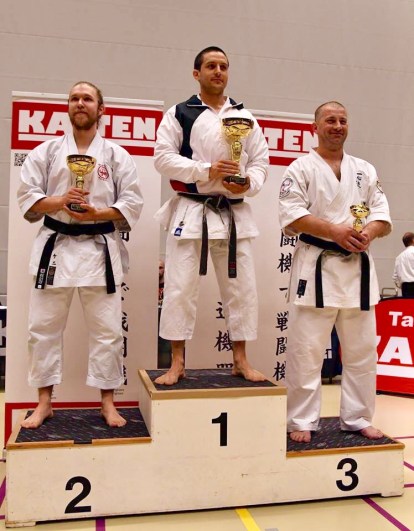
It should be noted that the Shingo Ryu Cup, is an open karate event for all styles, so the categories of kata are quite attractive and varied in terms of technique and principles of each style. This year, stand out among the participating styles, Kyokushin, Oyama Ryu, Ashihara, Goju Ryu IOGKF, Shotokan and Isshinryu, being these last two those who reigned the podium this 2018.
ISSHINRYU KARATE DO – SEISAN KATA
BUSHINKAN SHOTOKAN KARATE DO – JION KATA
After three previous rounds, the final of the category was disputed between a competitor belonging to the Shotokan style, who made a wonderful presentation after which, Diego sensei performed the Kusanku kata, in a version with competitive timing but maintaining the bases of Isshinryu.
In this way and by unanimous decision of the judges, the representative of Seishinkan and Isshinryu is crowned champion for the second year in a row with a splendid performance.
The podium of the senior kata division was as follows:
1st Place:Diego Rodriguez Inzunza, Isshinryu Seishinkan. Sweden
This event also turned out to be a wonderful opportunity to reunite the Isshinryu family in Europe, as it brought together the various schools, clubs and practitioners from Romania, Denmark and Sweden who, in turn, represented WUIKA and Isshinryu in a very good way.
Seishinkan participates in the acknowledgements for the effort and support of WUIKA Europe through its representatives who were supportive throughout the event. A sensei Lars Andersen, Mads Nørby and Martin Frederiksen.
We extend a cordial greeting and thanks to the organization of the 31st edition of the Shingoryu Cup waiting to see you again in 2019.
Texts by Diego Rodriguez
Videos courtesy of Mads Nørby
Images courtesy of Bushinkan Karate-Do & Karate News
JOEN NAKAZATO SENSEI – OKINAWA SHORINJI RYU KARATE
The event, held for the first time in Scandinavia, was organized by the school Shorinjiryu Sweden, led by Robert Iversen Sensei and had representatives from Finland, Sweden and the special participation of Diego Rodriguez Sensei from Chile, who is currently based in the capital of Sweden.
The various training session was developed by the following instructors:
Robert Iversen Sensei, Okinawa Shorinji Ryu Sweden, 7th dan.
Kim Mitrunen Sensei, Okinawa Shorin Ryu Seibukan Finland, 5th dan
DIEGO RODRIGUEZ SENSEI – Okinawa Isshinryu Karate & Kobudo
The training sessions were aimed at showing and developing the similarities in the techniques and principles of the three styles. This is how the training itinerary was divided into:
The overall balance of the activity was positive on the part of the instructors and participants who valued instances like these to develop greater perspectives of Okinawan karate and enrich their training process in each style.
BO BASICS
ISSHINRYU BASIC BUNKAI
ISSHINRYU PRACTICAL APPLICATIONS
SHORINRYU SEIBUKAN – KIM MITRUNEN SENSEI
ISSHINRYU BASIC APPLICATIONS
ISSHINRYU SEISAN KATA TRAINING
ISSHINRYU SEISAN KATA BUNKAI
BO BASICS
ISSHINRYU SEISAN KATA APPLICATIONS
Participants from other styles of karate such as Shotokan rated the instance as a great opportunity to learn more about the origins of their style and discover similar principles and techniques in Okinawan roots.
The event is planned to take place annually and rotationally in the different Scandinavian countries, with the following meeting being scheduled for 2019 in Helsinki, Finland, and organized at that time by Kim Mitrunen sensei and the Shorin Ryu school of that country.
OKINAWA SHORINJI RYU
OKINAWA ISSHINRYU KARATE & KOBUDO
OKINAWA SHORIN RYU SEIBUKAN
Seishinkan Budo Europe and the community of Isshinryu in the region highlight, support and appreciate the initiative to create a common space for the practice, development and promotion of Okinawan karate and Kobudo with an integrating perspective and in search of the universal principles that characterize the martial art practiced by thousands of people around the world.
—————————————————————————————————————————————
Pictures courtesy of Lasse Centervik & Shorin Ryu Seibukan Finland.
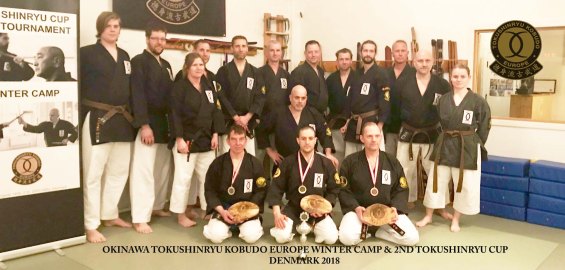
With a magnificent logistical deployment and excellent organization by Tokushinryu Kobudo Valby Shibu, the 5th Winter Camp and 2nd Tokushinryu Cup took place, an event attended by representatives and kobudokas from Sweden, Germany and various regions of Denmark.
The event held on March 2, 3 and 4, focused various activities and training sessions aimed at delivering new perspectives of training, various guidelines and updated technical standards in the various katas and general curriculum of Tokushinryu Europe.
SAI vs SAI KUMITE
PECHIN KUMI SAI DRILL
NUNTI SAI BUNKAI
SAI vs KAMA
The training sessions by Lars Andersen sensei were dedicated to developing Tokumine no Kon Renzoku bunkai Kumite (click to watch), whose base is in the kata proper and in the first two steps of the bo kihon. By performing the kata with a partner, he gives a new perspective on training and understanding the kata itself. Pechin Kumi Sai (click to watch) was the other topic of bunkai, which gives a base to develop different variants of double weapon against double weapon.
The session with Jan Overgaard sensei was dedicated to the bunkai and principles of the Sai and Nunti Sai.
2nd TOKUSHINRYU CUP
MARTIN FREDERIKSEN SENSEI & DIEGO RODRIGUEZ SENSEI TOKUSHINRYU CUP 2018 1st PLACE
TOKUSHINRYU CUP 2018 1st PLACE
In the framework of Winter Camp activities, the 2nd Tokushinryu Cup was successfully carried out for the second year in a row, whose main objective is to grant the participants the opportunity to demonstrate their technical level through the execution of the various katas in a competitive environment and the instructors, the possibility of observing the competitors and evaluating in what level the general technical standard of the organization is found in the different dojos.
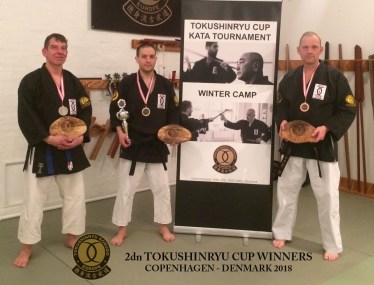
The applied regulation continues with the standard used in the events of previous years, that is, long weapon in the first round, short weapon in the second round and free option from there. According to this regulation and after four rounds, Diego Rodriguez Sensei is crowned champion after having presented the following katas: Tokumine no Kon, Hamahiga no Tonfa, Tokushin no Nunti Sai and Chatanyara no Sai.
The medal table was left in the hands of the following representatives:
1st place: Diego Rodriguez Sensei, Seishinkan. Stockholm, Sweden.
2nd place:Michael Guddat, Hamburg, Germany.
3rd place:Tonni Christian Petersen, Gotokukan Hvidore, Denmark.
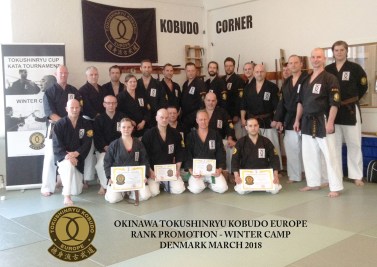
GRADUATION & BLACK BELT EXAMS
As usual, during summer and winter training, exams are held for those who are prepared and authorized by their respective instructors.
In this opportunity, Diego Rodriguez sensei presents a test for 2nd dan, within the framework of the special training program that started almost 3 years ago and which has been constantly monitored by Jan Overgaard sensei as a mentor and Lars Andersen sensei as director of Tokushinryu in Europe. The organization also welcomes Pernille Hansen, the new shodan who officially begins the long growth and learning path in Tokushinryu Kobudo.
NIDAN EXAMINATION – MARCH 2018
PERNILLE HANSEN – SHODAN TOKUSHINRYU KOBUDO EUROPE
Seishinkan Europe wants to extend its deep thanks at to Tokushinryu Kobudo Valby Shibu for the splendid organization and hospitality and to Tokushinryu Kobudo Organization for his constant support.
The last activity carried out by the author during that weekend was a technical training with Jan Overgaard sensei, in which he reviewed general kata details, Nunti Sai bunkai, Tokushin no Yari and Tokushin no nunti Bo.
Next March 17th and 18th, 2018, will take place in Stockholm, Sweden, the event called 1st OKINAWA KARATE & KOBUDO NORDIC SEMINAR, SWEDEN 2018, IN THE FOOTSTEPS OF GRAND MASTER CHOTOKU KYAN”
The main objective is to carry out a historical/practical revision of the styles developed from Kyan sensei’s teachings, such as Shorinji Ryu, founded by Joen Nakazato sensei (1922-2010), Shorin Ryu Seibukan founded by Shimabukuro Zenryo (島袋 善良)sensei (1908-1969) and Isshin Ryu founded by Shimabuku Tatsuo (島袋龍夫) sensei ( (1908-1975).
JOEN NAKAZATO SENSEI – OKINAWA SHORINJI RYU KARATE
Tatsuo Shimabuku 島袋龍夫(1908-1975)
The event organized by the school led by Sensei Robert Iversen, Kyoshi 7 Dan (first foreign student of past grandmaster Joen Nakazato Hanshi 10th Dan), will gather representatives of these styles in Scandinavia to carry out two days of training for all lovers of Karate and those who seek to delve into the roots of the more contemporary styles derived from Shorin Ryu.
INSTRUCTORS OF THE SEMINAR
SHORINJI-RYU: Mr Robert Iversen, Kyoshi 7th Dan (first foreign student of past grandmaster Joen Nakazato Hanshi 10th Dan).
OKINAWAN KARATE NORDIC SEMINAR, STOCKHOLM SWEDEN 2018
OKINAWAN KARATE SEMINAR STOCKHOLM 2018 OFFICIAL
GRAND MASTER CHOTOKU KYAN 1970-1945
JOEN NAKAZATO (first to the left) & GRAND MASTER CHOTOKU KYAN IN A PRE-WAR PICTURE AFTER TRAINING
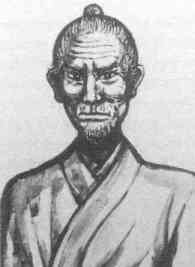
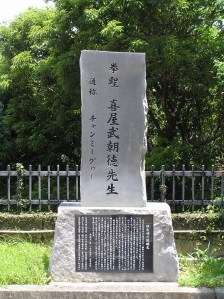
Chotoku Kyan ( 喜屋武朝徳) is one of the most popular names in various historical sources related to Okinawan Karate, both in its origin, development and the significant influence it had on the styles that were founded later on from its teachings.
Born in the year 1970, in the city of Shuri, Okinawa, Kyan sensei stands out for being a tremendously cultured man, with knowledge of Chinese and Japanese literature, the undoubted legacy of his father, Chofli Kyan, a man also tremendously cultured and well educated who served as an officer of King Shotai, the last to reign over the until then known as Ryukyu Kingdom.
Various historical sources describe Kyan sensei as a man of slim build and with repeated health problems, making him look more like a scholar man than a karate teacher. It is presumed that he could also have presented problems in sight, which would explain his nickname “Chanmī-gwā” or “little squinty-eyed”.
Between the years 1882 and 1886, he travels with his father to Tokyo in various embassies of the king, to continue with his training and studied at the same time, Chinese classics at the school known today as Nishogakusha University.
Back in Okinawa, in 1890, Chofli Kyan realized the potential of his son, now 20 years old,
SOKON “BUSHI” MATSUMURA
to become a fighter and aware that he could no longer provide the severe training that he required, to take advantage of his privileged power in the court, to take it to Sokon Matsumura, the King’s main instructor.
From the year 1892, Chotoku Kyan had the opportunity to train with all the most outstanding karate instructors in Okinawa, arriving at a solid base in the Shuri Te. Some of the most prominent ones were Matsumora Kosaku sensei, with whom practice the Tomari Te and learns the kata Chinto and Oyodomari Kokan sensei, Tomari Te, from whom he learns the Passai Kata.
In 1910, he travelled to a Yaeyama Island to learn Tokumine No Kun, but upon arriving on the island Kyan found that Tokumine, who had been exiled to the island for fighting the police with his Bo, had died. The landlord where Tokumine had lived offered to teach at the now famous Chotoku Kyan, the Bo kata of Tokumine. In the year 1922, he learns the Kusanku kata from a man named Yara.
Some of the students of Master Kyan were Arakaki Ankichi, Shimabuku Taro, Shimabuku Tatsuo (founder of Isshin Ryu), Shimabukuro Zenryo (remained a constant student until the death of Kyan and founder of Shorin Ryu) and Nakazato Joen (founder of Shorinji Ryu).
JOEN NAKAZATO SENSEI – OKINAWA SHORINJI RYU KARATE
SANSHIN KATA
Kyan Sensei was one of the survivors of the battle of Okinawa in 1945 but died of starvation for delivering his food to children who needed more than him. This story is tremendously known for human courage in such hard times that they took Master Kyan to be known as “The Saint” and his grave is visited frequently to know his legend.
MONUMENT OF KYAN CHOTOKU, located at the side of the parking lot of the Kadena Town Youth Center, Okinawa.
TATSUO SHIMABUKU SENSEI, ISSHINRYU & THE LEGACY OF GRAND MASTER CHOTOKU KYAN
Shinkichi “Tatsuo” Shimabuku (島袋龍夫) Sensei, born in Okinawa in 1908 and founder of the Isshinryu (一心流) style, records a very peculiar life as a peasant’s son and with a very hard childhood. Being the first of ten children, at age 13 he began his training in martial arts under the tutelage of his uncle, who later sent him to study Shorin Ryu with Master Kyan.
Shimabuku sensei was an innovator but also one of the most accomplished traditionalists of his time who mastered the finest principles and techniques of Okinawan Karate ( 沖縄空手) and Kobudo (古武道). He learned from great masters the most important systems of the island such as Naha Te, Tomari Te, Shuri Te and Kobujutsu. Under the tutelage of Chotoku Kyan sensei, one of the most perfectionist and severe teachers of the time learns the principles of Shorin Ryu.
MAKIWARA
DAI SENSEI TATSUO SHIMABUKU
Tatsuo Shimabuku 島袋龍夫(1908-1975)
SHIMABUKU SENSEI -AGENA DOJO, OKINAWA
SANSHIN KATA
ISSHINRYU KOBUDO – SAI KATA
His training with Kyan sensei began in about 1927, in the village of Yomitan, Okinawa. In a short time, Shimabuku would become one of the best students of Kyan, learning from him the katas: Seisan (十三), Naihanchi (ナイハンチ), Wansu (ワンシュー), Chinto and Kusanku/Kūshankū (クーシャンクー), in addition to Tokumine nu kon and basic Sai. He also began his study of “Ki” (or “Chinkuchi; (チンク”) “in the Okinawan dialect) by which Kyan was best known.” Shimabuku studied with Kyan until 1939.
WUIKA & SEISHINKAN Europe cordially invites all those interested to participate in the first version of this event, which is planned to be held in each Scandinavian country once per year.
More information on the following link or write us directly.
Seishinkan is a school of traditional Martial Arts of Okinawa Japan, which in 2017 celebrates 30 years after having officially opened its doors in 1987. Today, with a strong pedagogical orientation and a multidisciplinary approach, Seishinkan tackles the practice of Karate-dō, Kobudō and related arts as central axes to guide the daily work of our dojos and representatives in different parts of the world, providing a powerful added value to the process of regular training of our students.
Molded under the hand of the west and rooted in Okinawa, Seishinkan has been a school chosen voluntarily throughout history by many people as an alternative of growth; a practice that goes beyond the physical perspective and technical aspect that aims to satisfy the most profound needs that at first, we have difficulty defining and visualising, besides granting in many cases, the bases to develop later the own path in other oriental arts.
Today, ad portas to end the 3rd decade of operation of our school, we went to review a bit of history, the philosophy that holds and at the same time has been shaping what is now recognised as a school with solid foundations in Budō.
Back in the years, our school was recognized under the name of SESSHIN 接心. Instructors camps, made at that time less frequently, focused mainly on the development of topics that would promote the understanding of the correct way to practice martial arts, which all students shared in a rather unconscious state.
Strictly speaking, Sesshin refers to a type of meditation carried out in certain Buddhist monasteries. Especially prolonged, it is done once a month from April to August and from October to February. Commonly practised by some Buddhism schools, it provides, according to experts, a powerful tool for the observation of the inner personality.
The literal translation of the kanjis of Sesshin would be “recollection of the spirit“, “touching the spirit “,” touch the essence“
A detailed description is made by Smed (2001): “Meditation begins at three in the morning in summer and at four in winter continuing until late at night with intervals to eat, perform exercises and relax. In the monasteries, during the period of meditation they pronounce themselves speeches daily and before that, the environment is available for the practice to be performed…”
In the book “Zen and Martial Arts: Presentations”, the same author mentions the Sesshin carried out in his dojo as “long instances in which calm and silence reigned in all the immobile postures of Zazen and then give rise to the Kumite. Regardless of the notions of victory or defeat, the great lesson of these sessions was that it did not matter if the kumite was placed inside or outside, in any case, it will always be against ourselves, therefore, it will always lead us to the spirit of the path”.
This slideshow requires JavaScript.
On the other hand, the literature related to the study of Buddhism, also points out that Sesshin corresponds to the retreats of the monks to the temples where the main activity is meditation; Buddhist practice by excellence whose meaning can be understood as “cultivation, training of the mind”, assuming therefore a certain predisposition so that the practitioner is situated in reality. According to the practitioners, Sesshin “helps people to look inside and thus get rid of feelings like greed, anger and ignorance”. It is here also where different KUSEN (Ku, the mouth Sen,education, teachings, Oral Teachings of the master during the Zazen) take place and that in the case of the initiates, they try to deepen in the existing relations between meditation and action (Deshimaru, 2002).
This slideshow requires JavaScript.
In the context of our school, it represents the first signs of a particular way of living and feeling the martial art, which has been finding its development and evolution until today.
From it, originate the idea of our camps / seminars; an activity that grants a unique seal and characterises our organisation, where long training sessions are carried out and also meditation sessions until late at night in search of the development of the denominated, by those then, “Sesshin Warrior“.
In the beginning, a Sesshin Warrior must be strong in mind and body, always prepared for the unpredictable; be balanced in their way of life and governed by the following moral code:
SESSHIN LOGO THROUGHOUT THE 80’S
It must be in harmony with the Law of Pure Potentiality.
Shall understand, accept and live harmoniously with the law of Karma.
You must learn the law of detachment.
You must cultivate a strict code of self-discipline.
Must understand, seek and live the law of Dharma.
You should cultivate patience, respect and moderation wisely.
You must practice the “Give” law.
SEISHIN:
Origin and evolution of a Philosophy.
Our school established in 1992 the link officially with the OIKKA (Okinawa Isshinryū Karate & Kobudō Association), an organisation founded by grand master Angi Uezu. Throughout the years and with several trips to Okinawa, Osvaldo Rodriguez sensei continues to develop the foundations that sustain the philosophy of the Sesshin school, until in 2006 and as part of a new tour to Okinawa, a trivial conversation with Uezu Sensei takes unexpected rivulets: thanks to his guidance and advice, the name that identifies our school is finally revealed.
“SEISHIN”, BY UEZU SENSEI
That which varies substantially is found in the literal meaning of the ideograms that express Seishin, specifically in the kanji “SHIN”. The kanji originally selected, according to Uezu Sensei, did not correspond to what was wanted to express in reality nor did it represent the spirit of our school. For this reason, the kanji Shin of “Heart” is modified, by that of “Spirit“.
“SEISHIN IS A LIFE STYLE REFLECTED IN THE MOVEMENT OF OUR SCHOOL THROUGH ISSHINRYŪ, KENDŌ, KOBUDŌ AND AIKIJUJŪTSU. THE KANJIS REFLECT THE WAY OF SEEING AND TEACHING THE MARTIAL ARTS USING THEM AS TOOLS TO EDUCATE AND INSTRUCT THE INNER WARRIOR. IT IS RELATED TO HARMONY, SPIRITUAL DEVELOPMENT AND IS STRONGLY LINKED TO THE SUPERIOR LAWS THAT GOVERN THE UNIVERSE”
At this point, it is important to understand what the true meaning of contemporary Oriental Martial Arts has been, and specifically those that relate to our regular practice. It is public knowledge that martial arts emerged strongly linked to the development of the old war conflicts in Japan, at a time when man faced face to face with the truth of living or dying.
Towards 1868 and with the beginning of the Meiji restoration 明治維新, Martial Arts ceased to relate directly to the war and became considered “psychophysical education systems, based on the regular practice of self defence techniques with or without weapons, oriented to sublimate the natural aggressiveness of the human being “(Gomez, 200., p.1), giving a turn towards the inner growth of man and socially useful purposes.
OKINAWA
OKINAWA
OKINAWA
OKINAWA, 1837
KENDO
KENDO
The Budō武道 was born, a modern term normally used to indicate the practice of martial arts as a way of life that embraces the three dimensions of the human being (Body – Mind – Spirit). Added to this, is the fact that there was an important group of karate masters who believed and rescued the high formative and educational value that some combat methods had and decided to turn these practices towards the internal development of their students.
Budō is the soul of Seishin, and being this a set of Japanese Martial Arts whose practitioners are governed by a set of ethical rules referring to their application in a similar way to what the code of Bushidō 武士道 represents for the ancient samurai, it will not be strange find values and transversal principles in each of them.
WHERE TO BEGIN: “THE DŌ”
Having understood the true goal of the practice of Martial Arts, you can begin to develop a path that must be travelled to meet the highest essence of each practitioner and thus lead to the discovery of themselves.
Understanding Budō武道 as a path of personal refinement that should impact the student in its three dimensions, have established different stages that must be experimented with the goal of making progressive and methodological the transit of each one through the art he is practicing.
1st stage: Etiquette and Good manners; necessary to have an appropriate vocabulary and environment to the context of a traditional Dōjo.
2nd stage: Physical development; as a consequence of a regular and systematic training, the basic and complex physical and psychomotor qualities are stimulated, giving the student a dominance and increasing discipline of his own corporality.
3rd stage: Technical Domain; obtained through the systematic practice of the Kihōn, Katas, Self Defense and Kūmite inherent to each Ryūha. Strongly develops mental strategies for the control of variables such as anxiety and fear, stimulating self-confidence and self-efficacy of the student. It corresponds to one of the fundamental pillars for the next stage, given which stimulates the mind-body union in every action.
4th stage: Mind and Spirit; where it is necessary to adapt the behaviour to a strict ethical and moral code that, together with the understanding and application of the principle Ichi Go Ichi E at all times, certain mental faculties will awaken that will help the development of an unbreakable union between body, mind and spirit.
IVAN SENSEI & DIEGO SENSEI
SANSHIN KATA BY DIEGO SENSEI 2013
SANSHIN KATA BY DIEGO SENSEI 2014
ETIQUETTE – UEZU SENSEI 2006
SEISHINKAN BUDŌ SCHOOL, THE INSTITUTION:
Mission & Vision; a look towards the future
OKINAWAN KARATE & KOBUDO FEDERATION, CHILE. 2004
In the field of leadership, the importance of building a mission and institutional vision is widely recognized and until today, deeply studied.
Since the Institutional Vision is the one that fundamentally projects a mental image of the possible and desirable future, it must have the capacity to incorporate the dreams of those who conform it and to build an ideal to orient itself. It is intrinsically related to the values and principles of the organization that gives it its own stamp, an identity.
The Mission, on the other hand, constitutes the “reason to be” of an institution, corresponds to a broad purpose, that makes sense towards all the actions to be developed, determining “who serves” the organisation and what “needs satisfy”, making it distinguishable from similar ones (Lavin & Cols., 1997).
Seishinkan Budō School recognizes in both, important tools to improve the understanding process of which are the general, specific and transversal objectives of our organization, facilitating the transmission of values and tasks of the same.
“Behind respect, discipline, perseverance, etc., often, without realizing it, there is a much deeper meaning than we think when we practice a Martial Art. Many people ask if there is something more behind the technique, or only and exclusively the whole thing is reduced to a mere physical exercise “
Magaly Inzunza Sensei.Sesshin Institute, 1989
“Internal recollection, meditation and true knowledge within oneself are very difficult to achieve in today’s world … “
“… It is important to ask what I am looking for, where do I want to go? and then develop a strong will and great confidence in your Sensei, to achieve a single triumph: the triumph of the Spirit”.
Osvaldo Rodriguez Sensei. Isshinryu Sesshin, 1991
“Now, as we go deeper into the Physiology of Exercise, we will also do it in the knowledge of ourselves and more specifically of what happens to us while we have the privilege of being in the Dojo”
Enrique Bardiza. Physiology of Exercise, Vol 1. Sesshin Institute, 1989
The above quotes correspond to various excerpts of what for years has been one of the most unique features of our organization. The elaboration of writings, memoirs and volumes about different topics has been a trend that has evolved since 1987 to this days. From this, the following can be extracted:
Research Orientation. The cultivation of the mind through study, readings, development of a career of higher education or related studies, build a powerful link that will lead to obtaining one more step towards obtaining a “powerful personal philosophy”.
Unique Institutional Seal.That gives a powerful added value that allows generating objectives for the integral education of the Seishinkan Student. Stimulates the ability to transfer various knowledge, making them permeable to the practice of Karate-Dō.
Recovery of Educational value,revaluing what karate Masters envisioned decades ago.
“… the same happens in the Martial Arts, where a serious and competent organization gives credibility and confidence to the practitioner’s belt”.
Magaly Inzunza Sensei. “Martial Arts”. Sesshin Institute. 1987
“… the foregoing results in the need and relevance of effective leadership in increasingly complex organizations”.
Diego Rodriguez Sensei. “Need and relevance of a sustainable Leadership in org. of Martial Arts”.
Isshin Ryū Seishin. 2013
And on the other hand, the previous quotes, extracted from the most recent research and reports, show the growing concern that has arisen regarding the institutional value that Seishinkan has been gaining with greater intensity.
In summary, all the above corresponds to the process that has been taking place during the last three decades of operation of our organization that today continues in a constant process of evolution, marking milestones in various areas related to the daily work of the same, and making necessary establish and clearly define our identity to all members of the community.
Therefore, supported by the literature of the specialised area and based on the years of development of Seishinkan Budō School, the author presents an approach to the Institutional Mission and Vision of our organisation.
INSTITUTIONAL VISION
Seishinkan Budō School aims to become a recognised and distinguished martial arts organisation at national and international level, for the high standards in human, technical and professional quality of all its members. Due to its unique way of contributing to the integral development of human beings through the systematic practice of karate and related arts, its objective is to rescue, revalue and validate the deep educational and formative roots that make Karate and Kobudō of Okinawa unique and that has been transmitted through generation in generation up to our hands.
Presentation of the Research “Need and relevance of a sustained Leadership in Martial Arts Organizations”, San Sebastian University, Nov 2014.
INSTITUTIONAL MISSION
In addition to preserving the roots of Okinawa’s traditional arts, the central commitment of Seishinkan Budō School is to contribute to the integral development of the human being using the Oriental Martial Arts as the main tool due to its high philosophical and formative content, rescued decades ago by the Okinawan masters and preserved until today by thousands of dedicated practitioners around the world.
GENERAL OBJECTIVES
Maintain the legacy of all masters who represent the purest essence of Okinawan karate and kobudo, related martial arts and specifically the Isshin Ryu founded by Master Shinkishi “Tatsuo” Shimabuku.
Promote the codes and principles of Master Shimabuku.
Rescue the high value and philosophical content of the Okinawan Martial Arts and apply them to the formal and non-formal education system.
Use the Karate-Dō & Kobudō as a valid way of integral education of the movement, delivering a new alternative and field of study for the physical activity and motor skills sciences.
Provide space and support to any organization and/or school that promotes the values and principles of Okinawan Karate-Dō and related Martial Arts.
Establish networks and alliances with different organizations of Oriental Martial Arts, national and international and contribute in this way to the enrichment of the practitioners of our organization.
SPECIFIC OBJECTIVES
Nurture constantly our students of different knowledge concerning the practice of Isshin Ryū Karate dō, oriented towards the maximum theoretical and technical development of all Seishinkan students.
Provide opportunities for professional development, through the training of instructors capable of successfully performing the teaching of karate and kobudo as a physical activity.
Provide to parents and guardians who trust in our children’s project, an alternative to support the school education process of their children through the regular and systematic practice of Karate & Kobudō.
Provide support to formal and non-formal education organizations that decide to incorporate the practice of martial arts into their educational curriculum as a way to contribute to the integral education of their students.
Stimulate and generate in our students the ability to transfer the Dojo’s learning to everyday life.
Deliver practical tools for personal development
Nurture your students of solid philosophical foundations that contribute to the search of a personal path of grow.
TEXTS EXTRACTED FROM THE MEMORY “RIOKY BUDŌ – THE WAY OF THE INNER STRENGTH ” & “NEED AND RELEVANCE OF A SUSTAINED LEADERSHIP IN MARTIAL ARTS ORGANIZATIONS”
Research developed by Diego Rodriguez Inzunza , on the occasion of his examination for 4th dan, YON DAN, in 2014. Organization Seishinkan, Chile
Between the past 2 and November 14, 2017, an unprecedented event took place, that mobilized various organizations from different countries with the aim of carrying out a tour through several Isshinryu and Tokushinryu’s dojos in Romania.
Diego Rodriguez Sensei of Seishinkan Europe, was sent as a representative by the WUIKA(World United Isshinryu Karate Association) and Tokushinryu Kobudo Europe to contribute to the development and expansion of both Isshinryu and Tokushinryu in Romania. The organizations, through the representative in Europe, Lars Andersen Sensei, have relied on the work of our organization to contribute to this promising project of unity and strength of the different serious Isshinryu organizations that have traditional roots and connections with Okinawa.
In this framework, the event “WUIKA & TOKUSHINRYU KOBUDO TOUR, ROMANIA 2017”, is part of the strategic plan of WUIKA to “bring together all the Isshinryu organizations around the world with the only goal of growing, expanding and sharing knowledge and training of the traditional Isshinryu to the new generations”.
WUIKA & TOKUSHINRYU EUROPE TOUR 2017
WUIKA & TOKUSHINRYU EUROPE TOUR 2017
The dojos that were part of this tour, and to whom we extend our deep thanks for the organization, enthusiasm and hospitality are the following:
General basic principles, stances and Isshinryu kihon were the topics developed in all the Dojos, in addition to some general corrections in various katas.
Andreea and Alex sensei were promoted to Nidan, 2nd Dan by WUIKA, after having presented the technical program for the respective grade and having received the pertinent corrections.
KARATE KID STAGE
SEISAN KATA
UPPER BODY BASICS
BASIC ISSHINRYU APPLICATIONS
BASIC APPLICATIONS
POSTURE AND BASIC TECHNIQUE
OKINAWA ISSHINRYU BASIC
ISSHINRYU KOBUDO TRAINING & CORRECTIONS
SEISAN KATA
KICK BASIC
ESSENTIAL PRINCIPLES
KIHON STAGE
KICK BASICS
BASICS
BASIC ISSHINRYU APPLICATIONS
UPPER BODY BASIC APPLICATION
Several conversations about the relevance and impact of the activity and future projects also took place during the tour. Parents, political authorities and students expressed their joy and support to the hosting senseis for the activity and also provided the warmest welcome to Diego sensei in each of the dojos that were part of the activity, a situation that will undoubtedly turn this tour into something memorable.
ANDREEA DIANA – NIDAN, 2nd Dan WUIKA
ALEX COVASA – NIDAN, 2nd Dan WUIKA
TOKUSHINRYU KOBUDO EUROPE
George Craciunescu sensei was in charge of hosting the Tokushinryu Kobudo seminar at his school. Review and correction of the complete curriculum until the 1st Kyu and some katas was part of the content of the different training session.
It is worth mentioning that we have the relevant presence and collaboration of Pavalati Roman Sensei, member of Tokushinryu in Romania, who, together with Diego sensei, made a joint effort in correcting technical details, in addition to sharing several training sessions with George and Alex sensei in order to review more advanced katas.
The opportunity was also taken to examine the students who then presented all the technical curriculum required by Tokushinryu Europe for the respective kyu ranks. They were successfully approved and exhorted to continue their training with the same effort and dedication.
PAVALATI ROMAN – RODRIGUEZ DIEGO – CRACIUNESCU GEORGE – COVASA ALEX TOKUSHINRYU EUROPE – Romania 2017
C.S. RYUKAY, Tokushinryu Kobudo – George Craciunescu Sensei
TOKUSHINRYU EUROPE – ROMANIA TOUR 2017
KYU RANK TEST
KIHON GENERAL CLASS
KIHON GENERAL CLASS
GENERAL COMMENTS AND EVALUATION
The overall balance and perception of the activity by students, senseis and responsible organizations has been positive, highlighting the relevance and need to generate new instances of exchange and training that ultimately benefit the future generations of Isshinryu.
For our part, we highlight tremendously the disposition of the authorities and the way in which they have developed the policies that allow giving space to these instances of growth.
We reiterate our thanks to the representative of WUIKA and Tokushinryu in Europe, Sensei Lars Andersen and his school, Joshinkan for sponsoring and contributing significantly to the realization of the activity and for sharing the ideals in the teaching and expansion of Okinawan Karate and Kobudo.
To the various clubs, their senseis, students and parents for supporting this initiative in Romania, which allowed us to set an important precedent for the future of Isshinryu in the country and the world.
C.S. PHOENIX DOJO’S WELCOME
C.S RYUKAY – GEORGE SENSEI & ALEX SENSEI
C.S. SHINOBI JUNIOR BLACK BLET
C.S. KOKORO’S FAMILY
C.S. RYUKAY STAGE
ISSHINRYU: THE WAY OF ONE HEART
C.S KOKORO’S INSTRUCTOR
LUMINITA DAN SENSEI
MIHAI SENSEI GIVIN AN IMPORTANT RECOGNITION TO SENSEI DIEGO FOR THE SUPPORT AND TEACHINGS DURING THE ACTIVITY
C.S. HIKARU DOJO’S FAMILY
BOGDAN SENSEI & DIEGO SENSEI
GEORGE SENSEI – ALEX SENSEI
ISSHINRYU ROMANIA’S FAMILY
ISSHINRYU ROMANIA’S FAMILY
Finally, we wish to express our joy and greater enthusiasm to see how Isshinryu & Tokushinryu contributes to the ultimate goal of Budo through its disciplines: build better people, with a strong mind and body, noble spirit and above all with a good heart.
Last September 2017, the second version of the already established Tokumura Cup & Summer Gasshuku in the city of Nakskov in Denmark, which gathers approximately 45 practitioners from the different dojos of Europe, is completed.
The activity was successfully organized by Lasse Jensen and Dorthe Jensen sensei, both belonging to the host dojo.
Three days of intense training in each session led by the instructors Lars Andersen Sensei, Mads Nørby Sensei, and Per Søresen Sensei who made corrections and unified the technical standard in the curriculum for Tokushinryu Europe.
This slideshow requires JavaScript.
After several sessions and corrections, there are many aspects to improve in various katas and aspects of the curriculum.
The Tokumura Cup, developed during the morning of Saturday, had as winners after several rounds to the following senseis. 1st ROMAN PAVALATII SENSEI, Torakai Romania. 2nd DIEGO RODRIGUEZ SENSEI, Seishinkan Sweden. 3rd MARTIN FREDERIKSEN SENSEI, Honbu dojo Denmark.
This slideshow requires JavaScript.
MORE TOKUMURA CUP & SUMMER GASSHUKU NEWS IN SOCIAL MEDIA
On May 6th, 2017, in the framework of the 30th anniversary of Shingo Ryu Cup, a new version of this event was developed in the city of Næstved, Denmark. Competitors from Romania, Chile and all parts of Denmark mainly gathered at the Næstved Arena to compete in the Kata and Kumite categories.
This slideshow requires JavaScript.
After the cordial invitation of Sensei Lars Andersen, Sensei Diego participated in the representation of Seishinkan in the category of Kata obtaining a meritorious first place, besides a wonderful and unexpected recognition to the best technique of the championship.
On February 4, 2017, during the traditional seminar of instructors and Tokushin Ryu Cup, Diego Rodriguez Sensei presented exam in Tokushin Ryu Kobudo for 1st Dan Black Belt together with other students and the instructor and his tutor Jan Overgaard for 3th Dan.
The process began around 8 months before with the Lars Andersen Sensei’s designation of the Copenhagen hombu dojo instructor Jan Overgaard, as tutor and guide in the training process and the assimilation of new technical standards by the author. Kihon, katas, bunkai and philosophy were and part of the training to this day.
BO – TEKKO BUKAI – HOMBU DOJO COPENHAGEN
This slideshow requires JavaScript.
Kihon and the complete program including Bo, Eku, Tekko, Tichu, Sai, Nunti Sai, and the Bo – Bo and Bo – Sai kumite were part of the requirements examined under the watchful eyes of Lars Andersen Sensei and Mards Nørby Sensei, two of the highest ranks in Europe.
SHODAN TEST
TOKUSHIN NO TEKKO
JAN SENSEI & THE AUTHOR
TOKUSHIN NO NUNTI SAI
LINK, PROCESS AND HISTORY OF TOKUSHIN RYU & SEISHINKAN
TOKUSHIN RYU PATCH
One of the main objectives that motivated the journey to Denmark of the author, has been the search for growth and deepening the learning of Martial Art. Kobudo has been a concern that Seishinkan has had over the past few years; the intention to find a link with Okinawa and to deepen the practice of the management of traditional weapons has motivated to establish contact with the organization Tokushin Ryu in Europe, directed by Sensei Lars Andersen and to begin thus an arduous way of practice and investigation.
NUNTI SAI
TOKUMURA KENSHO SENSEI
Tokushin Ryu Kobudo corresponds to the system created by the master Kensho Tokumura who, after 50 years of combined training of Karate & Kobudo, decides to develop his own system based on his experience, learning and own vision. Tokushin Ryu Kobudo is an eclectic system that is based on the traditional weapons of Okinawa which emphasizes powerful technique utilizing ‘Chinkuchi’. It is a blend of traditional Kobudo weapons and includes obscure weapons that were in danger of becoming historically lost.
Master Tsuyoshi Uechi & Diego Rodriguez Sensei 2016 Kata Seminar Harslev – Denmark
Denmark, November 2016
Uechi Tsuyoshi Sensei, 8th dan Joshinkan Okinawa Isshin Ryu Karate & Kobudo Kyo Kay was the last month of November dictating a kata seminar which was organized in a splendid way by Martin Frederiksen Sensei and Nellie Brasted, both belonging to Joshinkan Isshin Ryu in Denmark.
Uechi Sensei Harslev Gashuku
Sensei Diego as a student and ambassador of OIKKA Seishinkan Chile, participated and taking the respects of all the students of Seishinkan, as well as sharing a full weekend of grow and training with Uechi sensei, and all the studens of Joshinkan Europe.
This slideshow requires JavaScript.
It should be noted that Uechi sensei was the former president of OIKKA (Okinawa Isshin Ryu Karate & Kobudo, founded by grand master Angi Uezu in 1990) and one of the first students of Uezu sensei. Sensei Osvaldo Rodriguez and several students who have traveled to Okinawa and USA have had the opportunity to share and train with this great Master and great person at the same time.
This slideshow requires JavaScript.
The seminar in Harslev covered the katas Seisan, Seiunchin, Naihanchi, Wansu and all the Kihon.
Special thanks of the author to the organizers for such a wonderful event and to Lars Andersen Sensei for the invitation


















 Our school established in 1992 the link officially with the OIKKA (Okinawa Isshinryū Karate & Kobudō Association), an organisation founded by grand master Angi Uezu. Throughout the years and with several trips to Okinawa, Osvaldo Rodriguez sensei continues to develop the foundations that sustain the philosophy of the Sesshin school, until in 2006 and as part of a new tour to Okinawa, a trivial conversation with Uezu Sensei takes unexpected rivulets: thanks to his guidance and advice, the name that identifies our school is finally revealed.



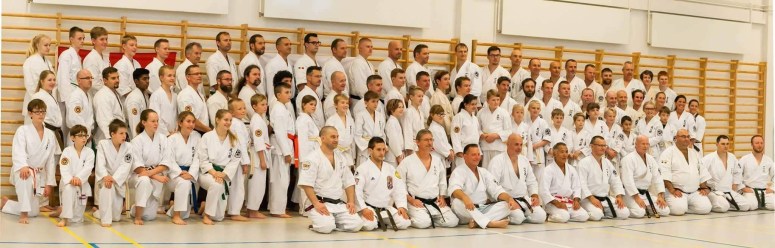


 SEISHINKAN BUDŌ SCHOOL - Älvsjö Karate & Kobudō