“OKINAWA KOBUDŌ START UP & DEVELOPMENT PROGRAM: Okinawan Weaponry”
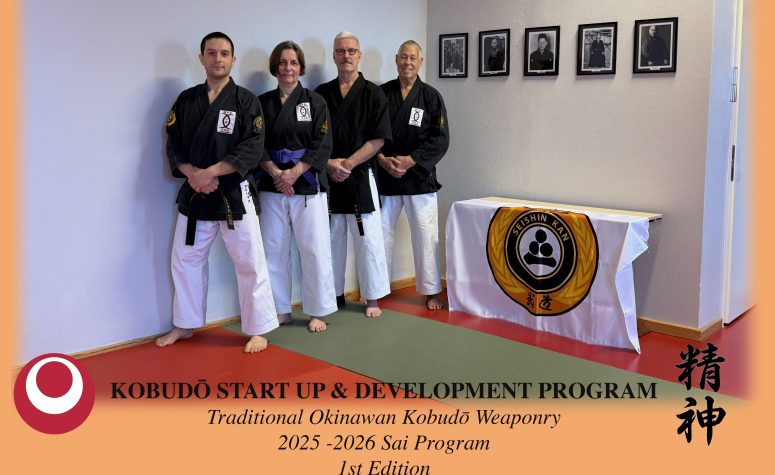
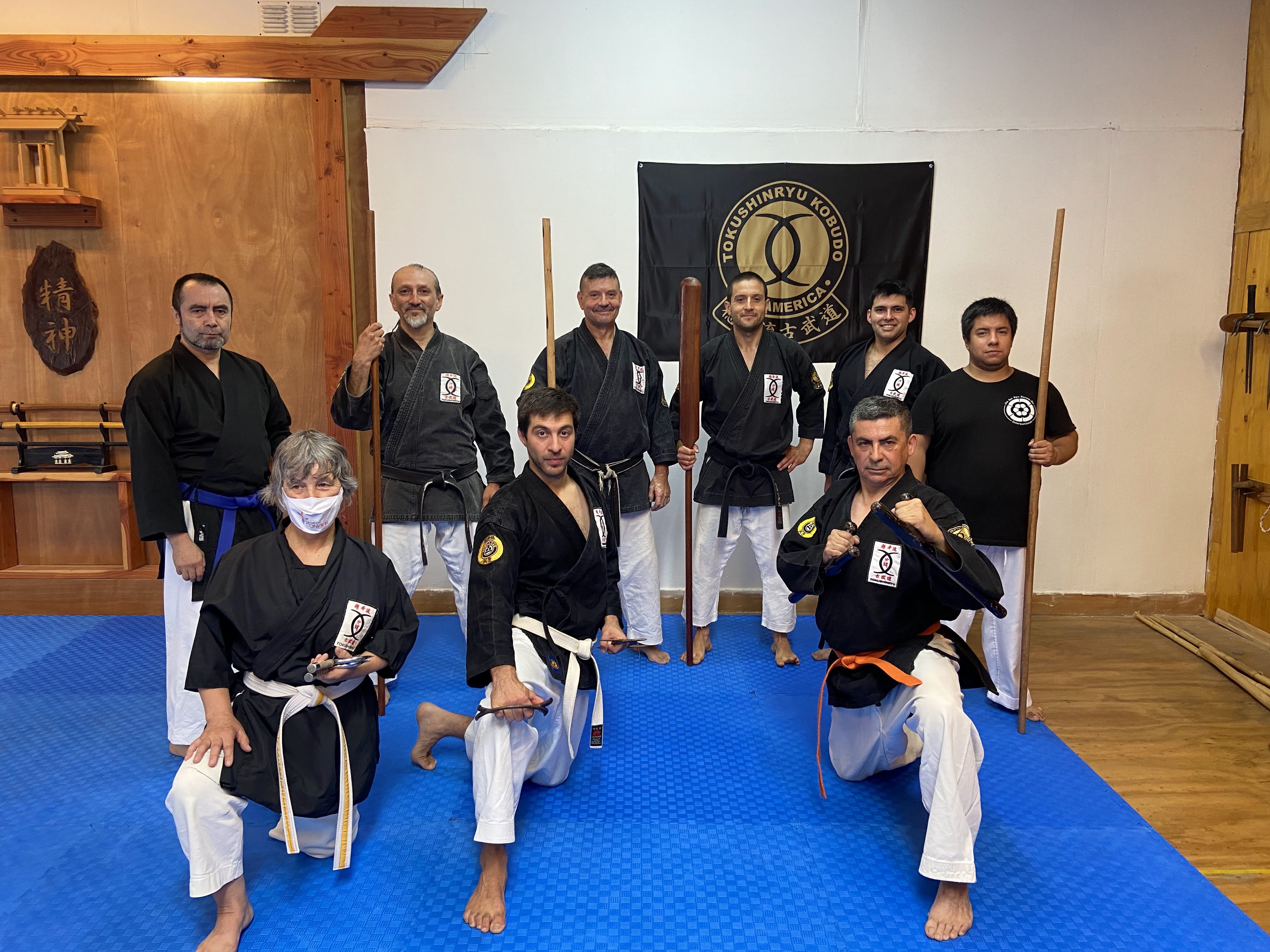
August 2025 marked the launch of the inaugural edition of the “Start Up & Development Program: Okinawa Traditional Kobudō Weaponry,” specifically featuring the Sai module. This program has attracted dedicated kobudokas from diverse regions including Sweden and Chile, all of whom are participating in this initial cycle.
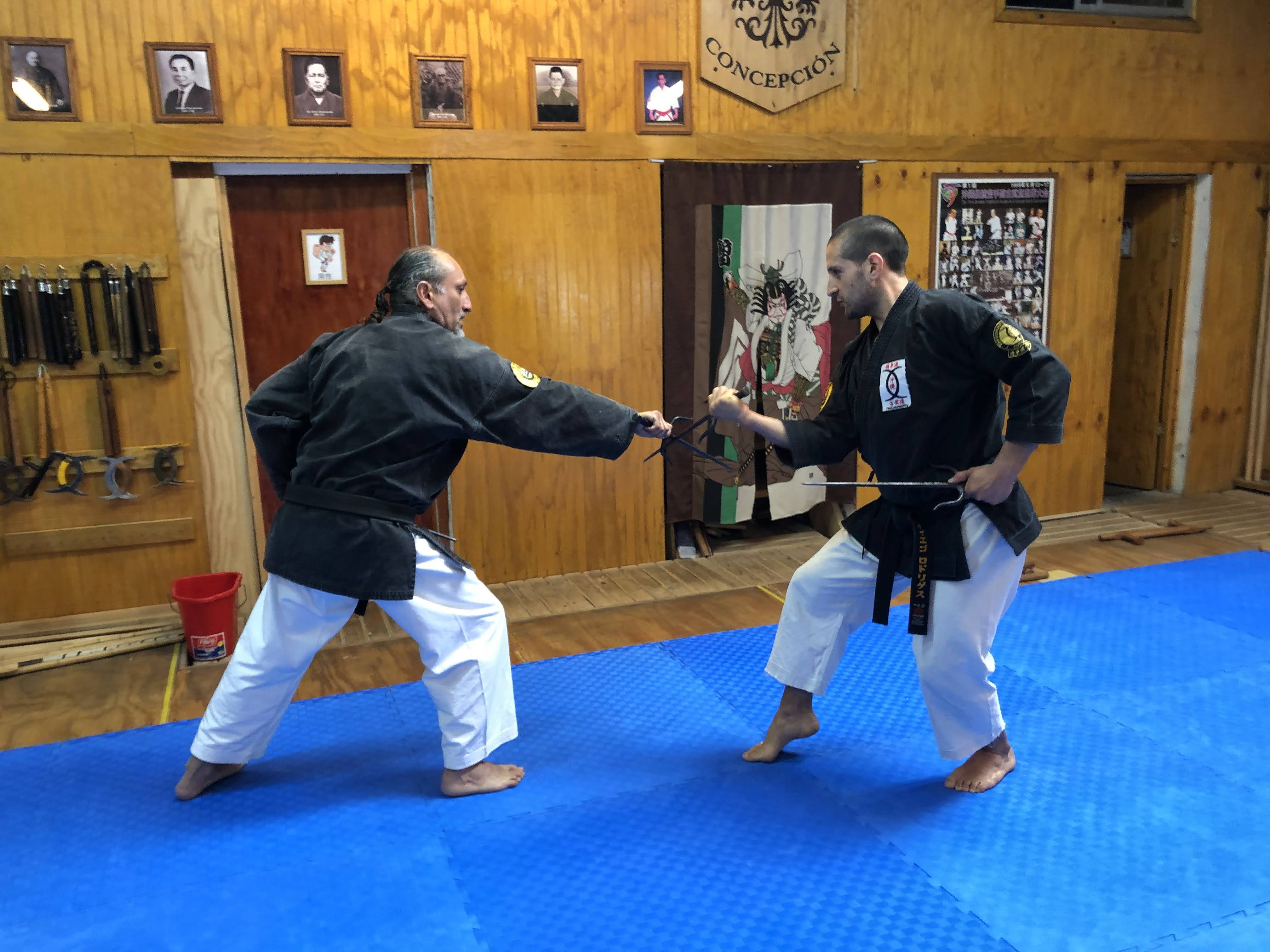
The primary focus is on mastering the techniques associated with the Chatanyara nu Sai 北谷屋良ぬ釵, Hamahiga nu Sai 浜比嘉ぬ釵, Yakka nu Sai 屋嘉阿ぬ釵, and Kusankū sai 公相君サイ katas. Through a combination of extensive feedback and personalized kihōn training, participants are honing their skills and deepening their understanding of these traditional Okinawan weapons.
For those interested in exploring more about the Sai 釵, Bō 棍 and Tonfa トンファーprogram, additional information can be accessed through the link bellow. Alternatively, inquiries can be directed to us via email at seishinkanbudoschool@gmail.com.
We encourage anyone passionate about traditional Okinawan martial arts to reach out and learn more about the enriching experiences our program offers.
SENSEI ULF GRANATH GOJURYŪ KARATE KENSHINKAI – FARSTA KARATEKLUBB Stockholm, Sweden
MARTIAL ARTS PROFILE
1979 begin training Okinawa Gojū Ryū.
1994start Farsta Karateklubb, a well-regarded and recognised traditional martial arts center in Stockholm, Sweden, dedicated to fostering okinawan karate spirit among the students and contributing to the development of karate instructors that support the dojo’s ongoing growth nowadays.
1999 training under the direction of GKI (Gojuryu Karate International)
2004 -2022training under Kanenobu Iryo Sensei (RIP), head of the Swedish branch of the International Kenshikai Organization, presided by Hokama Tetsuhiro sensei.
2005start training directly under Hokama Tetsuhiro sensei, Okinawa.
2023makes contact with Tokushinryū Kobudō in Sweden.
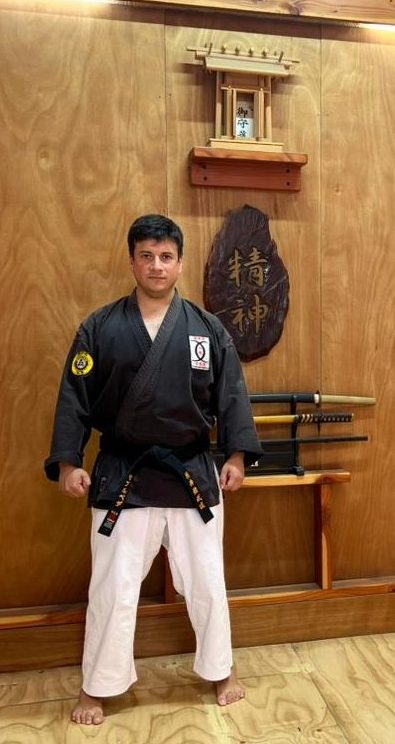
“Mitt mål med att delta i programmet är att utveckla min kobudō träning fortlöpande, både tekniskt och mentalt. Att få en djupare förståelse för hur de olika kobudo-vapnen kan användas. Att även försöka lära mig mer historia om de olika vapnen och de olika katorna och dess ursprung”
MR. MENNO DJIK SHORINJIRYŪ KARATE, MATAYOSHI KOBUDŌ & TOKUSHINRYŪ KOBUDŌ Stockholm, Sweden
MARTIAL ARTS PROFILE
2005 Start at Märsta Okinawa Karate dō Förening, Shorinjiryū Sweden. Martial art organisation, Okinawa Karatedō Shorinjiryu Shinkokai.
2009Expand training now also with Kobudō, mainly Matayoshi Kobudō but also from other styles.
2021makes contact and begin his training in Tokushinryū in parallel with earlier styles.
Robert Iversen Sensei – Shorinjiryū & Matayoshi Kobudō, Sweden
Diego Rodriguez Sensei – Tokushinryū Kobudō, Sweden.
CURRENT RANK:
Shorinjiryū Karate Sandan, 2017
Matayoshi Kobudō Nidan, 2020
Tokushinryū Kobudō Shōdan, 2025
PARTICIPATING IN:Sai – Bō and Tonfa modules
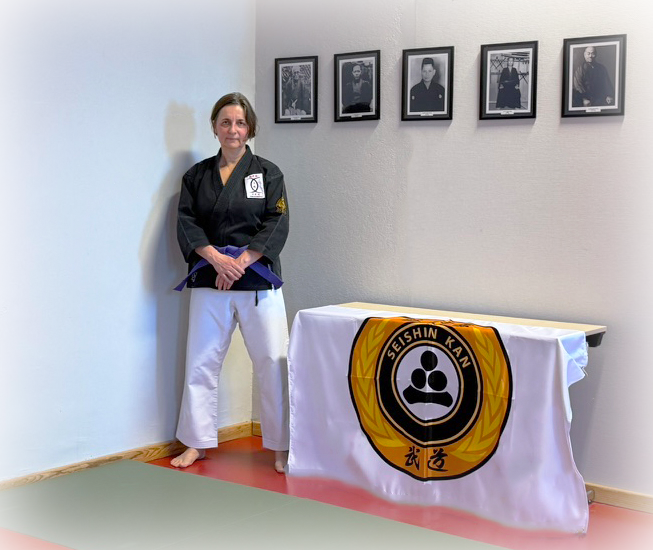
“Developing and learning more is always my driving force, curiosity and understanding how others reason and think. Sometimes questioning and pondering. Continuing the journey gives both the body and the mind a fantastic opportunity to develop and retain things that you slowly lose at old age.“
MR. JUAN MANUEL SEPULVEDA ISSHINRYŪ KARATE & TOKUSHINRYŪ KOBUDŌ Concepcion, Chile
MARTIAL ARTS PROFILE
2015 begins training in Isshinryū Karate & Kobudō under Osvaldo Rodriguez sensei at the Seishinkan Budō School in Chile.
2017begins training in Tokushinryū kobudō under Osvaldo Rodriguez sensei in Chile, after visiting Diego Rodriguez sensei in Copenhagen, Denmark.
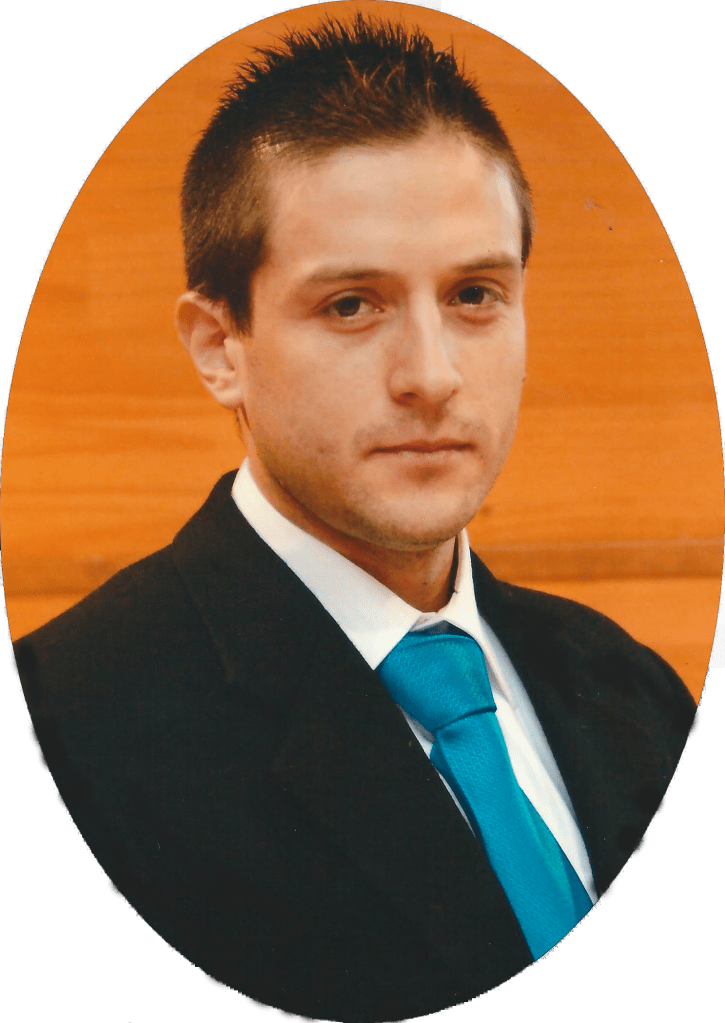
“I see this as an excellent opportunity for professional development in an area of great interest to me. The program content is appealing and innovative, reinforcing aspects of my current studies and incorporating new ones“
MRS. INNA SOROKA
SHORINJIRYŪ KARATE & TOKUSHINRYŪ KOBUDŌ
Stockholm, Sweden
MARTIAL ARTS PROFILE
2008 Start at Märsta Okinawa Karate dō Förening, Shorinjiryū Sweden. Martial art organisation, Okinawa Karatedō Shorinjiryu Shinkokai.
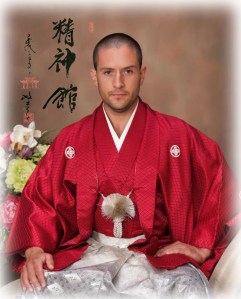
DIEGO RODRIGUEZ INZUNZA Bachelor in Education – Physical Education Teacher
Born in the city of Concepción, Chile, in 1987.
Started training karate at the age of 6.
Graduated in Educational Sciences in 2012.
Graduated as a Physical Education Teacher in 2013.
Instructor at Seishinkan Budō School HQ between 2012 and 2017.
Moved to Sweden in 2017.
Join Internationella Engelska Skola Company, Älvsjö, in 2018.
Became Head of the Physical Education Department in 2019.
Established the Seishinkan Budō School in Sweden in 2021, continuing his family’s legacy to this day.
It’s my conviction that martial arts have the power to influence people’s lives and make them useful to society, regardless of their field of practice, and it’s even more powerful when combined with formal education.
What one may experience and acquire through martial arts transcends mere techniques; it encompasses numerous human and spiritual dimensions. This includes exhibiting courtesy to demonstrate respect for one’s opponent, putting in the utmost effort to achieve a goal, focusing intently on a particular technique or movement, and utilising each moment to cultivate a purified mind. Furthermore, it involves the qualities of perseverance and endurance, achieved through the repetitive practice of the same techniques for the purpose of improvement and personal growth. The significance of “persistence is power” cannot be understated, as concentration becomes essential at critical moments, and perseverance empowers one to persist even when faced with adversity. Ultimately, the true strength lies in the ability to conquer oneself, rather than merely surpassing others.
This has been and will continue to be the foundation around which I pursue my professional career”
Born into a family with a strong tradition in the field of Education, Sports and Physical Activity as well as Martial Arts, he started at an early age to stimulate specific skills to work among people at his parents’ martial arts development center (Seishinkan Budō School) in the city of Concepción, Chile, a place where instructional tasks were assigned to lead groups of different ages. This nurturing environment not only allowed him to develop his own proficiency in martial arts but also instilled in him essential qualities such as leadership, empathy, and communication. As he guided children and young adults through various forms of self-defense and physical training, he became acutely aware of the impact that proper mentorship can have on an individual’s self-esteem and personal growth. The experience gained from these formative years played a determinant role in his future professional career options, ultimately shaping his aspirations to blend his passion for education and sports into a meaningful contribution to society. Through these early interactions, he learned how to inspire others, fostering a love for physical activity and promoting healthy lifestyles which he continues to advocate for to this day.
Graduated in 2013 from the “Universidad San Sebastián” www.uss.cl/en as a Bachelor in Education and Physical Education Teacher, has since then been involved in daily work with children, adults, and seniors in the fields of education, physical activity, health promotion, and competition.
Simultaneously with his academic development, managed to sustain a successful career as an active karate athlete, representing his Alma Mater in multiple championships at the regional, national, and international levels (most notably the Okinawa Rengokai Karate & Kobudō World Karate Championships, held in Buenos Aires, Argentina, 2010). His career earned him an athletic scholarship and earned him the “SAN SEBASTIAN SPIRIT AWARD” for three consecutive years, awarded by the educational institution to outstanding students who successfully develop their academic and athletic careers.
Driven by the passion for excellence, it’s the experience of achieving success and becoming someone who contributes to society by using these tools that he’s committed to pass to the next generation. He firmly believes that the knowledge and skills acquired through dedication and hard work not only empower individuals but also foster a sense of responsibility toward the community. In doing so, he aims to share these valuable insights with those who travel similar paths in formal education settings as well as through the impact of Seishinkan Budō School in Sweden, his parent’s legacy. This commitment transcends mere instruction; it involves inspiring young minds to embrace their potential and use their capabilities to affect positive change, thus creating a ripple effect of growth and empowerment throughout society.
Overview of main Roles to Date
PHYSICAL EDUCATION & HEALTH TEACHER – Graduated in 2013, Universidad San Sebastián. Concepcion, Chile. https://www.uss.cl/en/
HEAD OF THE PHYSICAL EDUCATION DEPARTMENT & PHYSICAL EDUCATION TEACHER – IES Älvsjö, Stockholm Sweden. 2018 to the present day.
SEISHINKAN BUDŌ SCHOOL – CHIEF INSTRUCTOR: since its official opening in 2021 to the present day in Stockholm, Sweden.
PERSONAL TRAINER & FITNESS ADVISOR in the Swedish fitness company Pulse & Träning (currently STC), Stockholm, Sweden. 2018 – 2021
COACHING PROJECT MANAGER – CYS WORLDSPORTS, focused on developing human capital in the Biobío Region, Chile.
MAIN ROLE DESCRIPTION
As the Head of the Department of Physical Education,Responsible for developing and implementing the curriculum according to Swedish school lawwith a main emphasis on the units of movement, safety on land, water, and contact with nature.
As a physical education teacher, and through his teaching ethic based on his personal experience in martial arts, seeks to instill in his students a sense of commitment to society and the development of skills beyond the merely academic, using physical activity as a tool for success in their future projects.
Develop & implement the “Ice Rescue Skills” projectas part of the Physical Education unit, Land and Water Safety, providing students with the opportunity to develop the skills needed to interact safely with Sweden’s challenging natural winter environment.
Developed & Implemented the CPR Unit Certificationat the school for all staff and Year 9 students. Also taught CPR to a younger group of students in preparation for their certification.
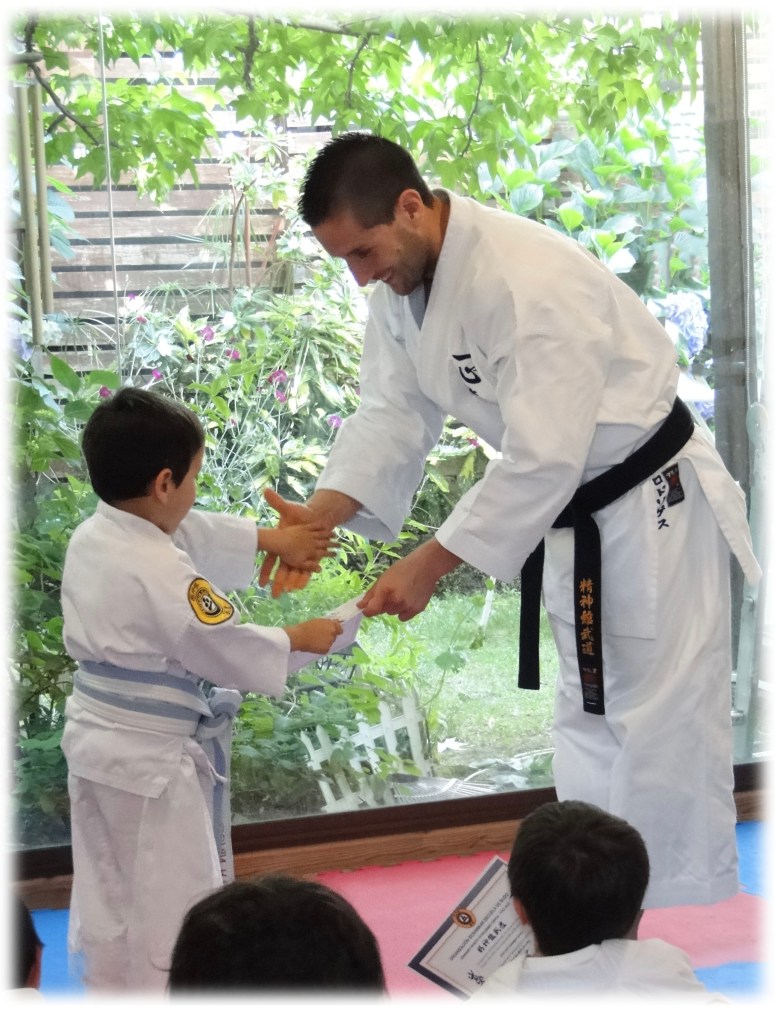
As Chief Instructor at Seishinkan Budō School Sweden, provides the space to students of all ages to explore the use of martial arts in their personal lives. From adults, who can train for health development purposes and cultivate it as a deep philosophy in their lifes, to children whose parents trust our work to support their children in becoming successful persons with an strong sense of purpose in the future.
As a personal trainer and sports consultant,develops postural correction and injury prevention programs for adults and seniorsand formulates specific training programs for junior tennis players.
Initiate the systematic training in Karate-do (空手道) at the age of six at the Okinawa Isshinryū Seishinkan Organisation, whose Hōnbu dojo is located to this day in the city of Concepción, Chile, under the guidance of his parents, Magaly Inzunza Sensei (Isshinryū Karate Yondan, 4th dan) and Osvaldo Rodríguez Sensei (Isshinryū Karate Hashi-dan, 8th dan and Tokushinryū Kobudō Nana dan 7th dan).
As full-time Martial Arts instructors and Physical Education teachers, they identified the potential of karate (空手) as a non-formal educational tool that supported his child’s development at school, university and later in his professional journey.
Driven by a deep sense of commitment to the ideal of giving back through martial arts and thanks to his professional training as a teacher, the use of martial arts as a tool for self-development has become one of the pillars and guiding principles of Diego Rodríguez Sensei, who remain committed to pass this to the next generation alongside the development and promotion of Okinawan Karate and Kobudō.
We invite the reader to briefly delve into his martial career to date.
Domo Arigato Gozaimasu !
どうもありがとうございます
1992 – Concepcion, Chile: Start training Isshinryū Karate dō (一心流空手道) under the guidance of Osvaldo Rodriguez and Magaly Inzunza sensei.
2008 – Concepcion, Chile: Promoted to Shōdan – 1st dan black belt, in Isshinryū Karate & Kobudō 一心流空手古武道. Formally begins to fulfil duties as an instructor at the Seishinkan Hōnbu Dojo, a task he had been performing for several years as an assistant instructor, being responsible for supporting fellow dojo members in their respective martial journeys.
2008 – 2013 Concepcion, Chile: while training to become a Physical Education Teacher, he served as an instructor and leader of the San Sebastián University sports karate team, to which he also was part as an athlete. The latter earned him a sports scholarship for the outstanding athletic record.
2014 – Concepcion, Chile:Promoted to Yōndan, 4th dan black belt, in Isshinryū Karate & Kobudō 一心流空手古武道, receiving on this occasion his Menkyō Kaiden免許皆伝 (License of total transmission, Instructor) in Isshinryū under the OIKKA (Okinawa Isshinryū Karate & Kobudō Association)of Grand Master Angi Uezu (1935 – 2024). The results of the research “Need and relevance of sustained leadership in martial arts organisations” were presented to the examination panel and students who attended the occasion.
2014 – Stockholm, Sweden: while visiting the country, the first steps to open Seishinkan Budō School and start teaching Isshinryū karate are taken. No official Isshinryū dojo yet has ever been open in the country.
2014 – London, England: attending and supporting Master Christopher Chase – Isshinryū Karate 10th dan and current OIKKA president – during the Isshinryū karate seminar and special training sessions.
2016 – Copenhagen, Denmark:after moving from Chile and supported by Osvaldo sensei, makes contact with Lars Andersen sensei, Isshinryū Karate Hashi-dan (8th dan) and Tokushinryū Kobudō Nana-dan (7th dan) and initiate an accelerated program in Tokushinryū Kobudō (徳身流古武道)that culminate with his promotion to 1st dan, Shōdan black belt and authorization to start teaching Tokushinryū Kobudō in Sweden.
2017 – Stockholm, Sweden:relocated after a year in Denmark, informal Isshinryū and Tokushinryū trainings take place.
2018 – Romania:lead an Isshinryū Karate tour for different cities representing WUIKA (World United Isshinryū Karate Association) thanks to the initiative and connections of Lars Andersen sensei, current WUIKA director in Europe.
2018 – Okinawa, Japan: Promoted to Gōdan, 5th dan black belt in Isshinryū Karate & Kobudō. Participation in the “1st Okinawa Karate International Tournament, Okinawa Japan”, reaching the round of 16th.
2018 – Concepcion, Chile:the first “WUIKA & Tokushinryū Europe, South America” exchange program was conducted with students from Romania who traveled to Chile and participated in regular training sessions for a month at the country’s various Seishinkan Budō dojos. The results of the research “Rioky Budō: The way of the inner strength” is presented to the students and examination panel presided by Osvaldo Rodriguez Sensei, thus fulfilling the final requirement of the Gōdan graduation process initiated in Okinawa earlier this year .
2018 – Stockholm, Sweden:responsable instructor for the Isshinryū trainings that took place within the frame of “The 1st Okinawa Karate Nordic Seminar” whose main goal is to bring together the Ryū-ha (styles) that derives from the teachings of grand master Chōtoku Kyan 喜屋武 朝徳(1870 – 1945) in the nordic countries.SEISHINKAN BUDO SCHOOL
2019 – Helsinki, Finland:responsable instructor for the Isshinryū trainings that took place within the frame of “The 2nd Okinawa Karate Nordic Seminar”, whose main goal is to bring together the Ryū-ha (styles) that derives from the teachings of grand master Chōtoku Kyan 喜屋武 朝徳 (1870 – 1945)in the nordic countries.
2021 – Stockholm, Sweden: Grand Opening of Seishinkan Budō School in Sweden. Isshinryū Karate and Tokushinryū Kobudō formal trainings began and offered to the martial arts community and public in general.
2022 – Okinawa Japan: promoted to Sandan, 3rd dan black belt in Tokushinryũ Kobudō by Tokumura Kensho sensei, Tokushinryū Kobudō founder, within the frame of the visit to Okinawa of Seishinkan Budō students from Chile and Sweden. Promotion is later conducted and validated also at the Tokushinryū Kobudō Europe headquarters, following the organisation guidelines, under the examination panel presided by Lars Andersen Sensei, European director for Tokushinryū Kobudō.
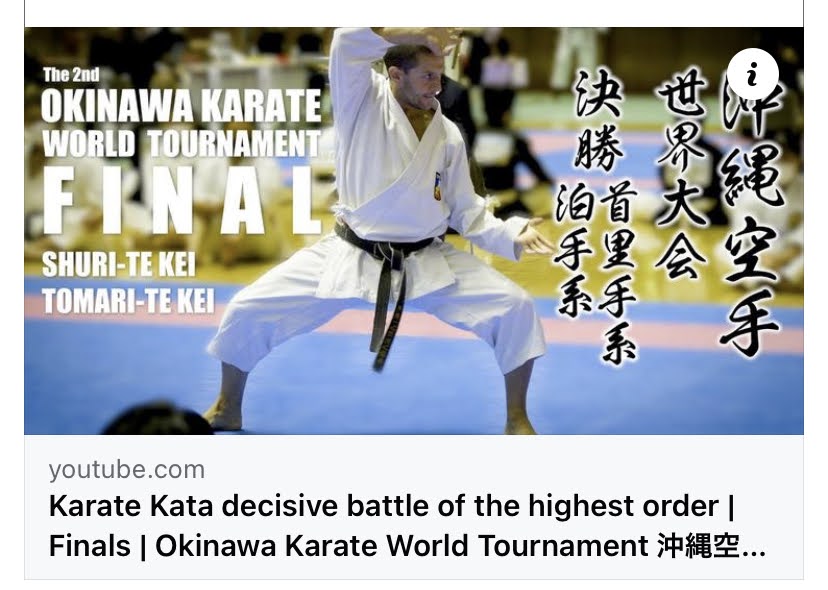
2022 – Okinawa Japan:Vice World Champion at “The 2nd Okinawa Karate World Tournament, Okinawa Japan”, Shuri/Tomari-Te Kei, Male 1, performing Isshinryū Karate Seisan Kata十三形and Sunsū Kataスンスウ形
2022 to date: as part of the personal commitment to excellence and continue learning process as martial arts student, annual visits to Uechi Tsuyoshi sensei and Tokumura Kensho sensei in Okinawa, Japan takes place, as well as the development of instructional programs for children and adults in Isshinryū Karate and Tokushinryū Kobudō in Stockholm, Sweden.
Thank you for your interest in our school and we hope the information here has been useful.
Today, martial arts, and karate in particular, are often viewed narrowly, either as self-defense or as a health-promoting activity. While both are widely valid, the best traditions of modern martial arts understand that combat effectiveness and health promotion are part of a holistic development that includes a high educational value, perfectly applicable, and even necessary, some might argue, in today’s society.
In an effort to pursue this ideal, Seishinkan Budō School has been implementing this holistic approach since its founding in 1987, with special attention to applying martial arts to the challenges of modern society, with children always being a special focus of development during our 38 years of operation with multiple generation of students taking part of our programs and parents placing their trust in our team of instructors.
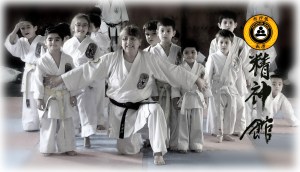
Our children program is designed to complement and support the formal educational process our students pursue at their schools. In a traditional Okinawan martial arts training environment and through recreational activities, students develop basic motor skills and fundamental values that permeates all human relationships. In a martial arts environment and in a mixed group of adults and children, students learn their place in the dojo while strengthening their self-confidence.
Starting from the age of 9 with a few exceptions (depending on the child’s level of independence) we offer tutoring twice a week.
We cordially invite you to read more details about our program below, or contact us directly via our email seishinkanbudoschool@gmail.com.
どうもありがとうございます
Domo Arigato Gozaimasu!
SEISHINKAN BUDŌ SCHOOL – Isshinryū Karate: A comprehensive, Integrated & Integrative experience.
Comprehensive: because it considers the student as a whole, not focusing exclusively on physical and motor development. Students also cultivate Okinawan martial arts in conjunction with the culture where this martial art originated, promoting a balance between intellectual and physical development.
Integrated: as it is a formative activity taught in a pedagogical manner so that it can complement the child’s formal education process in schools.
Integrative: regardless of their abilities, limitations, or potential, everyone can practice martial arts. Systematic training is carried out respecting individual levels of physical achievement and motor skills, adjusting them to make it an educational experience with an educational objective that serves society and is not merely competitive.
FORMATIVE PRINCIPLES IN MARTIAL ARTS FOR CHILDREN
Etiquette and Good Manners:which represents the fundamental basis to navigate the learning environment in a martial art. Procedures and etiquette are the pillars that allow to build an orderly, structured, and respectful environment for all students.
Physical and Motor Development:under the principles of gradual progression and systematic repetition, physical fitness is developed with special emphasis on the child’s motor development through multiple and diverse exercises.
Knowledge and mastery of the Techniques:where the child will seek to develop the skill, technical efficiency and aesthetic sense aimed at perfectly mastering the elementary movements in karate based on balance, management of the center of gravity (“tandem”, “Hara”), posture and breathing.
Mental and spiritual development: reserved primarily for students with years of dedicated practice who, through adapting their behaviour to an ethical and moral code called the “Code of Būshido,” achieve the awakening of mental and spiritual faculties. Self-knowledge, self-control, and meditation, among other relevant aspects, will guide the student through this stage.
ISSHINRYŪ KARATE – DOJŌ PRINCIPLES:
Discipline:
Correct attitude that every martial arts student must cultivate both internally (self-control, control of one’s actions and words towards others, self-knowledge) and externally (following the protocol and rules of coexistence when interacting with peers and elders)
Respect:
A value that, both individually and collectively, permeates all human relationships, both inside and outside the dojo. It is developed in each class through joint training with other dojo members, work with a partner (Uke), and adherence to the protocol for each class. It’s therefore, embedded in our daily operation.
Basic Technique:
Begins the physical practice of karate-dō through the execution of established patterns of movements consisting of positions, hand and leg techniques in order to develop maximum efficiency and body control in each movement.
Kata:
Forms of pre-established movements, executed in a harmonious and progressive sequence, which are deeply rooted in ancient Okinawan fighting traditions. They transmit a series of techniques through an “imaginary combat,” which enhances body balance, correct breathing, handling, and shifting of the center of gravity. Isshinryū karate has eight empty-hand kata: Seisan, Seiunchin, Naihanchi, Wansū, Chintō, Kusankū, Sunsū and Sānchin.
Self Defence:
Practical application of the four previous principles, which is developed with the other practitioner with the goal of improving the appropriate reaction to an unexpected aggressive situation. Always under the Sensei’s supervision, the goal is to develop maximum technical efficiency to control a real opponent in a real context.
Kumite:
The final practical stage of Isshinryū, which begins after years of intense training in the five previous principles have passed. In this stage, self-control in technical application and self-mastery, combined with the virtue of temperance, come together to calm the mind in a real combat situation.
“True mastery is to disarm with the mind only, being Kobudō purely a mean to this end”
Bushi Sanda Kanagusu Okinawa Ufushiku Kobudō
Ryūkyū 琉球列, the chain of Japanese island located on the boundary between the East China and Philippines sea, was considered for important historians as a significant weapons supplier in its early history. On several occasions superior militar powers demanded it to donate militar equipment to their causes, such is the example of the mongol empire in 1292 for their preparations to invade Korea and three hundred years later, were the warlord Hideyoshi from Japan who demanded the same for his preparation, this time, to invade Korea and eventual later conquest of the Mongol empire.
The latter briefly ilustrate the Ryūkyū importance and the historical background that led to the subsequent development and practice at the end of the 20th century in this place, of what is known today as Kobudō 古武道, formerly know as RyūKyū Kobujūtsu 古武術 (Lit. “Ryūkyū’s ancestral martial technique”). Originally and simultaneously practiced with the native fighting art Okinawa-te (沖縄手, Uchinaa-dii), today is possible to find schools dedicated entirely to the development of Kobudō and preservation of its techniques.
In an effort to contribute with its promotion among the martial arts community interested in deepening or beginning their journey in Kobudō, our institution officially launches the “2025 – 2026 Traditional Okinawan Kobudō Weaponry Start up & Development Program” based on the main Okinawan Kobudō 沖縄古武道 weapons detailed below.
DIRECTED TO:
Senior instructorsand assistantswho wants to initiate, expand and/or gain insight in one or more specific Kobudō weapon.
Dojō or specific training groupswith interest in expanding or including kobudō to their curricula
Practitionerswith martial arts experience
OBJECTIVE:
Starting, deepening or expanding the study of a specific weapon of traditional Okinawan weaponry.
Develop the essential teaching skills and technical competences to pass the curriculum of the specific weapon(s).
Further develop instructor(s) and assistant(s) of instructor in passing on the basics of the specific weapon
Build a solid foundation with the basic principles of kobudō that prepares the learner for advanced kobudō training and weapons.
OVERALL STRUCTURE:
Each program is divided into 3 modules that includes the practice of kihōn, kata and pre-established sparring exercises, taught progressively and according to the student’s level, constantly aiming to blend apprentice’s martial arts experience with it.
The programs does not lead to rank promotions / graduations, and finalise with a document certifying the completion of the specific(s) program (s).
DURATION: and frecuency to be conveyed with the interested party.
BŌ PROGRAM: up to 18 months
SAI PROGRAM: up to 18 months
TONFA PROGRAM: up to 6 months
ALL 3 PROGRAMS: up to 2 years
ABOUT THE RESPONSIBLE INSTRUCTOR:
Bachellor in Education & Physical Education Teacher with 15 years of teaching experience.
More details about the instructor can be found by CLICKING HERE
OTHER INFORMATION: For applications please click the following link. Pricing and program breakdown with specific details, please contact us by clicking the link or sending an email to the address specified below
Each program is based on three of the five main kobudō weapons within the Okinawan arsenal: Bō 棍, Sai 釵and Tonfa トンファー
BŌ PROGRAM: x3 Kihōn – x4 Kata – x3 Kumi bo
SAI PROGRAM: x7 Kihon – x4 Kata – x2 Kumi Sai
TONFA PROGRAM: x5 Kihon – x1 Kata – x1 Kumi Tonfa
Each program is scaffolded in 3 modules with the aim of facilitating the student’s transition from basic skills, through kata practice until reaching more complex sets of movements (Yakusoku 約束 commited or pre-arranged attacks and defences)
Module 1: Kihōn 基本 – Fundamentals きほん
Aimed at the stimulation and development of complex motor skills and naturalization of the techniques in the muscle memory of the practitioner through the use of the corresponding weapons.
This first stage is aimed at acquiring:
The form; accompanied by the correct ashi sabaki 足捌き (footwork) and dashi 立 (stances) to efficiently cope with the constant change of the center of gravity as a consequence of the execution of the techniques.
Muscular strength and speed:through the discovery to perfection of the agonist and antagonist muscles that act in each motor sequence (techniques)
Adequate breathingto be executed with each movement and transform this into an unconscious act, understanding that the practitioner does not breathe uniformly since each situation is changing and must adapt appropriately, moving from “Donto breathing” (normal thoracic) to “Ibuki-Nogare” (diaphragmatic with abdominal contraction without sound).
Module 2: Kata 形
Essential sensory integration process in sports practice (constant repetition of technical gestures), which supports the conditioning of the body, improvement of reflexes and movements, through the “principle of motor learning”. In this way, the practitioner can “reorganize” the motor response and give rise to movement patterns that adapt to specific contexts (free attack – Kumite). Depending of the program, the student will receive instruction in the main Bō, Sai and Tonfa kata that can be found today in almost every kobudō style.
Module 3: Bunkai 分解
From the traditional Okinawan view, simply practicing the form of a kata is not enough to develop a deep understanding of the meaning of the techniques and how to apply them correctly. The practice of bunkai 分解 – analysis or deconstruction for analysis – is a fundamental part of this process, otherwise we will only be in the presence of an athletic representation.
In this module, the program has an easy-to-assimilate progression that begins with the kihōn and their practical application against one or more opponents, until building the skills and confidence necessary to begin the kata analysis stage (module 2).
Yakusoku 約束- committed or pre-arranged attacks and defenses- based on the main techniques acquired in module 1 and 2, are also part of this module. Depending of the selected program, the student will receive instruction in:
Bō vs Bō 1
Bō vs Bō 2
Bō vs Bō 3
Sai vs Sai
Bō vs Sai 1
Bō vs Sai 2
Bō vs Tonfa 1
Bō vs Tonfa 2
PROGRAM DESCRIPTION:
I PROGRAM – BŌ 棍
Where the Katana, Naginata and Yari hold a place of honour within the bladed weapon arsenal of Ryūkyū, so Ekū and Bō held the highest steem among the wooden weapons, being the latest without a doubt, the most popular one within the Okinawan weaponry with presence in every Kobudō Ryūha and curriculum.
The prominence and increasing role of the Bō in Okinawa as a weapon can be attibuted to the King Shō Shin in the arly 16th century with his edict requiring all the feudal lords to move to Shūri and give up their bladed battlefield weapons to a collective warehouse with the pretext or false idea that this will decrease the risk of rebelión and therefore, make Okinawa a more peaceful place. At the same time, a police force or “chikudin” was created for security reasons and the weapon chosen to fufill its duty was the Bō, whose techniques also practiced by the palace guards, found the path to survival and development through Seikichi Uehara sensei’s Mōtobu Ryū.
In Okinawa, the man credited for introducing and establishing the Bō kata methodology is Sakugawa Satunushi Bushi, better known as “Tode Sakugawa” sensei whose most well know trainees were Sokon “bushi” Matsumura and Chinen Pechin.
Referred generically as Bō and also as Non or Kun whereas the term Bōjūtsu designated its practice.
3 kihon, 4 kata and 3 kumi drill make up our Bō program.
II PROGRAM – SAI 釵
Sometimes called the “trident truncheon”, this three-pronged iron truncheon is an iron and steel implement with two variants that facilitate the transfer of techniques from one to the other, these being the “Manji no Sai” (iron swastika) and the “Nunti Sai” (mounted iron baton). It’s known that the sai and nuntei have come from China and are said to have history going back to India.
After its introduction to Okinawa, this weapon adapted well to the Te techniques presumedly due its highly defensive capacity against a katana and the fact that could be readily concealed. Indications of its popularity imply that it did not reach high levels among the Bushi until the mid to late 19th century, considering the overwhelming evidence showing the Bō as the preferable weapon for law enforcement.
One of the most celebrated authorities with the Sai was Sanda “ Bushi” Kanagusuku, who became until 1879 the first “Uhushiku” or chief inspector of police after sharing bodyguard duties of the last King Shō Tai, with Sōkon “Bushi”Matsumura, from whom he received training in Sai and other weapon’s technique.
As a Uhushuki, his weapon of choice was the Sai and having under his direction the Wakisaji (police inspectors), Chikusaji (police sergeants) and Saji (constables) , instruction about the use of Sai became popular among local police, specially agains orthodox and street weapons. Supporting information about the sai was it was carried in sets of three by Ryūkyuan police officers.
Kanagusuku sensei later developed several techniques based on Te to dodge and hit simultaneously which were inherited by his students, among which Mōden Yabiku sensei 1882-1945 and Shosei Kina sensei 1882 -1981 stand out.
Nowadays, the continuing popularity of this weapon is provably due his basic hand operation, making relatively easy to pick up and if the student have the elemental empty hand punches, blocks and stances, he can navigate the techniques and soon demonstrate an acceptable level of mastery with the weapon.
7 kihon, 4 kata and 2 kumi drill make up our Sai program.
III PROGRAM – TONFA トンファー
With a proved existence in the Ryūkyū Islands as a kobudō weapon for over a century, it’s similar in appearance to the one known as the “side-handle truncheon” introduced during the late 20th century into the law enforcement in United States and Europe. Known also as Tunfa, Taoufa, Tuiha, Tunfua, Tonfua, Toifua among some others, it’s one of the five main kobudō weapons.
Older versions of this weapon consisted essentially of a square section staff with a round section handle that allowed the execution of most blocking Tōde techniques that can also be executed with the sai (that is upper rising, middle inside, middle outside and lower downward). Unique to the Tonfa is what can be described as centrifugal-swings by using the upper body and hips, usually comprising in & out horizontal, up & down vertical and in & out diagonal. As regard of the basic hold, it’s generally taught that the Tonfa should be held tightly at the handle and firm along the length of the forearm to prevent it from sliding and exposing the forearm when blocking for example.
Once again, the popularity of this weapon can be attributed to the minimal training required to be able to block any given long weapon by appealing to the instinctive response to block this attacks with the forearm.
6 kihon, 1 kata and 2 kumi drills make up the Tonfa program.
Finally our institution extend a warm welcome to write to us about any enquire or if you need further details about the programs detailed in this publication.
Commemorating exactly one month in which the finals of The 2nd Okinawa Karate World 第 2 回 沖縄 空 手 国 際 大 会 Tournament were held in Okinawa, after two days of qualifying and one more day of the main tournament, which saw the crowning of a new generation of dedicated and talented practitioners of Okinawan Karate, who despite the global contingency, demonstrated an indomitable fighting spirit and perseverance, values that are rooted in the depths of Okinawan Karate.
We leave below some words and impressions that will always fall short to convey the sensations that the karate community had the opportunity to experience during those days.
Before moving on to the review, we once again extend our deep gratitude to the entire Executive Committee of the 2nd World Tournament, Okinawa Prefecture, and to each of the volunteers who contribute with their efforts to make this another memorable experience for those who had the opportunity to participate.
どうもありがとiうございます
———————————————————————————————–
Okinawa, Naha, August 2022
As of March 31, 2020, the statistics released by Karate Kaikan indicated that Karate is present in 193 countries and regions, with around 130 million enthusiasts around the world where at least 60 million are active practitioners of this martial art originated in Okinawa, where to date, between 350 to 400 dojos and around 10,000 active practitioners can be traced.
The current flagship project of listing Okinawan Karate at the UNESCO World Heritage Site, led by the Okinawa Prefecture Culture, Tourism and Sport Department Karate Promotion Division, joins the systematic effort developed by Karate Kaikan to promote, develop, preserve and spread this martial art that day after day adds more followers.
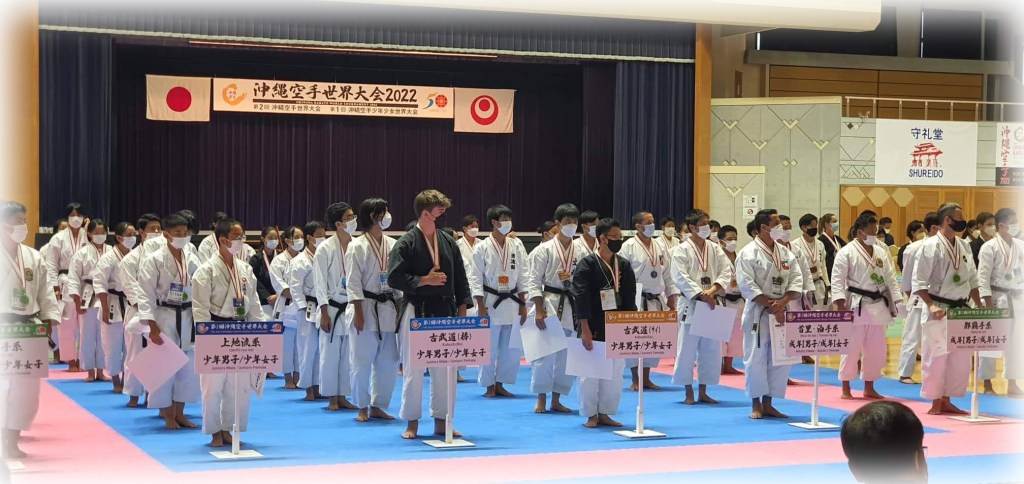
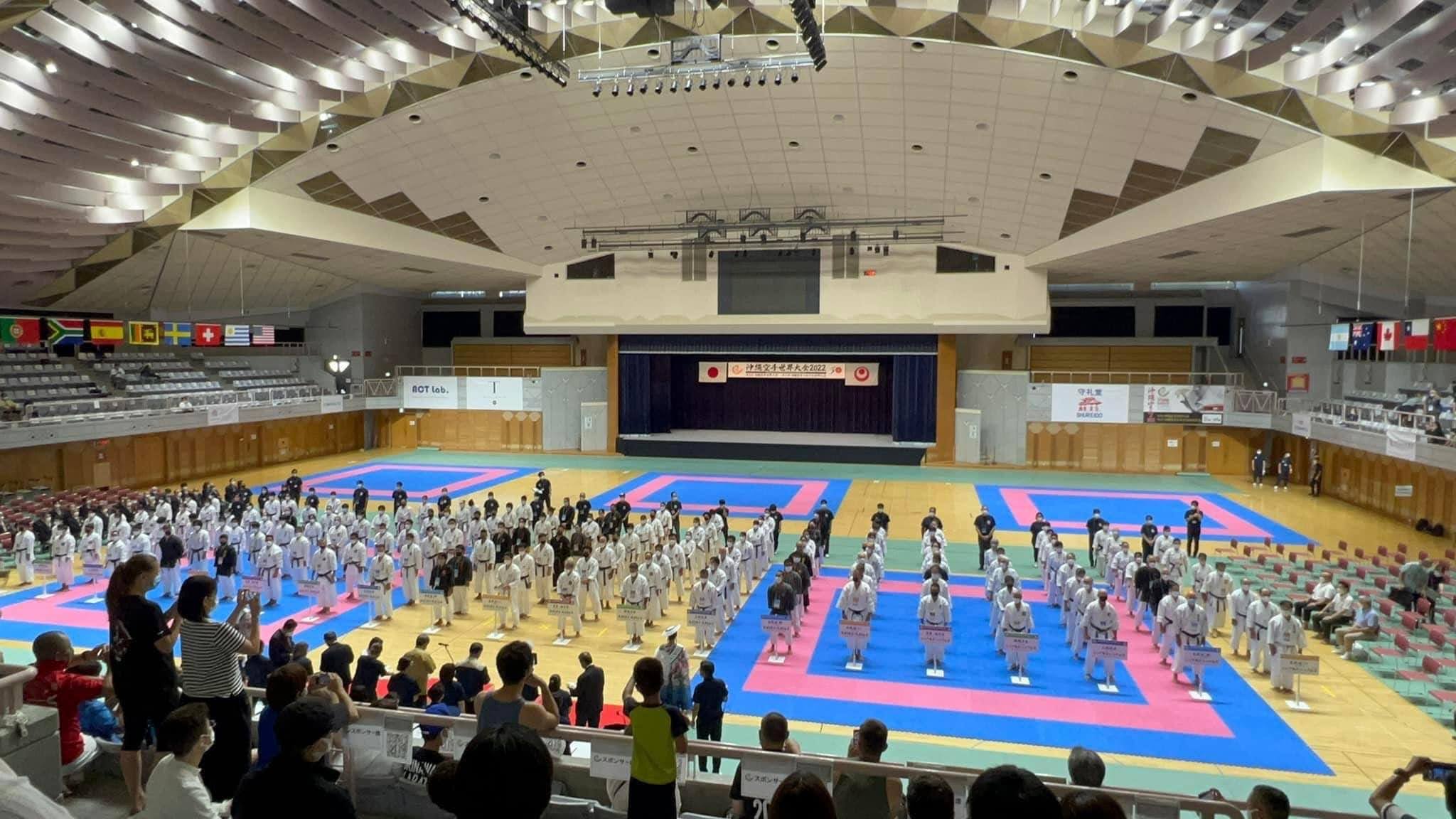
Among the projects sponsored by the Okinawa Prefecture (such as the Okinawa Karate international seminars, Okinawa Karate research project, The demonstration for “Karate no Hi” – Karate day on October 25) the realisation of the World Tournament continues to occupy an important space as a platform for promotion, recruitment and exchange between the participants. For this reason “The 2nd Okinawa Karate World Tournament”第2回沖縄空手国際大会 began on August 1 through August 9, despite the global contingency which undoubtedly impacted the travel from the attendants from overseas.
Around 830 participants, from 27 different countries, competed in kata of various styles in the adult division, to which were added the more than 1,360 participants of the 1st Okinawa Karate World Junior Tournament, an event that took place alongside the World Tournament this year.
Hosted by the 2nd Okinawa Karate World Tournament Executive Committee 沖縄空手実行委員会, the Okinawa Prefecture 沖縄県 and the Okinawa Dento Karatedo Shinkokai 沖縄伝統空手道振興会, the event aims to promote the entirety of the Okinawan traditional karate and kobudō. Seminars were held with the participation of around 840 participants, who had the opportunity to learn and appreciate the teachings of each of the selected masters in each style.
OKINAWa 2022: The Tournament Environment
Okinawa Times Newspaper – August 1st, 2022
“After years, the wait is finally over. The 2nd Okinawa Karate World Tournament and the 1st Okinawa Karate World Junior tournament will commence from august 1st to the 9 th. From the first day, masters who hold the Okinawa Prefecture-Designated Intangible Cultural Property “Okinawa Karate and Kobujutsu” will offer an inaugural demonstration at the “Special Dojo” of the Okinawa Karate Kaikan in the morning. In the afternoon, the opening ceremony will take place at the Okinawa Prefectural Budokan, where a total of around 670 participants will later have the chance to perform and exhibit their karate. On the end and the 3rd, the Junior World Tournament will be held at the Okinawa Prefectural Budokan and the Okinawa Karate Kaikan. There will be four divisions: Shuri/Tomari-te, Naha-te, Uechi-ryu and Kobudō.
After preliminary rounds for participantes form overseas, mainland Japan and remote island of Okinawa, the qualifiers will enter the main rounds. The awards and closing ceremonies will follow the final rounds.
For the Okinawa World Tournament, there will be 5 divisions. On the 4th and the 5th, the preliminary rounds for overseas, mainland Japan and remote island in Okinawa will be held. The Shuri/Tomari-te and Kobudō (Bō-Sai) divisions and the Uechi-Ryu and Naha-te divisions will be held respectively at the Okinawa Prefectural Budokan and Okinawa Karate Kaikan.
The tournament consisting in the last 16 will span from the 6th to the 7th. All divisions will complete their final rounds at the Prefectural Budokan on the 7th, where will be held the awards and closing ceremonies in the end.
On the 8th, the masters of each style will be invited to the “Okinawa Karate Seminar” for participants to get a taste of authentic karate”
TOP INTERVIEW, Okinawa Times.
The 2021 elected to the House of Representatives for Okinawa District 2, spoke about the current contingency in which the planning and development of the 2nd Okinawa World Karate Tournament took place.
In recent years, many around the world have faced hardships due various factors, from the COVID-19 pandemic to the Russian invasion of Ukraine. Yet it was needed in such hard times is an unyelding spirit, a quality that rest upon the core values of Okinawan Traditional Karate.
Thus it is hope that karate practitioners and enthusiast, around 130 million worldwide, will gather at the birthplace of karate, the “martial art of peace”, and fully experience both the spiritual and technical aspects that our founders have stablished.
Incidentally, as Okinawa saw the 50th anniversary of its reversion to Japan this year, the World Tournament seeks to be a place where participants can mingle and connect with fellow karatekas and gain deeper insight into the birthplace of karate. The Junior Wold Tournament will be held for the first time this year as well. It should be inspiring for the youth and the executive committee will take preventive measures in order to organise safe and secure tournaments.
The largest tournament where all the karate styles meet, The World Tournament will appraise the mans of preserving, transmitting and promoting traditional Okinawan karate. We also hope to make it an event that will push forward the registration of Okinawan karate in the UNESCO Intangible Cultural Heritage list.
Kunio Arakaki Social Democratic Representative for Okinawa District 2, elected in 2021
THE 8 INTANGIBLE CULTURAL ASSET HOLDERS 無形文化財, mukei bunkazai
It is well known that in Japan “Intangible Cultural Property” (無形文化財 Mukei Bunkazai according to the law) refers to those arts that have a high historical or artistic value for the country and the national government designates as the holder/s of these Important Intangible Cultural Property individuals or groups who have achieved advanced mastery of the technique of this Important Intangible Cultural Asset, in order to guarantee the transmission of traditional art. The recognition of the holders can be individual, collective or a group.
In 1997, Okinawa Prefecture designated “Okinawa Karate & Kobujūtsu” an intangible cultural property and certified three prominent authorities as holders. After that, 6 people were certified in 2000, 5 people in 2013 and 6 people in 2020. Now eight, excluding the deceased, are still making efforts to develop their great culture.
Morinobu Maeshiro – Okinawa Shorin ryū, Hanshi 10th Dan
Shintoku Takara – Uechi ryū, Hanshi 10th Dan
THE TOURNAMENT
The Okinawa Prefecture is sponsoring The 2nd Okinawa Karate World Tournament in order to promote traditional Okinawa Karate and the future of this ancient martial art, by creating an opportunity for Okinawan karate enthusiast from all over the world to gather and interact with each other at the “birthplace of karate“, as well as properly preserving and passing on the techniques and spirit of Okinawa Karate, which we inherited from our predecessors who systematised its practice.
Several events were carried out within the frame of the tournament such as the Enbukai – public demonstrations-, seminars, opening and closing ceremonies, exchange meetings and the tournament itself. The latter maintained the same categories for each division that were used in the first version held in 2018.
Juniors Male – Juniors Female 少年男子 – 少年女子 (newly implemented in 2022)
Adults I Male/Female 成年Ⅰ男子 – 成年Ⅰ女子
Adults II Male/Female 成年Ⅱ男子 – 成年Ⅱ女子
Seniors Male/Female シニア男子. – シニア女子
Recognised as a powerful platform to capture the attention of the world and promote the values inherent in the practice of Karate, on this occasion it has allowed all of us who enjoy the practice of Karate in Okinawa to learn valuable life lessons, at the hands of two great and honorable competitors.
In the record below, captured by Ageisho Japan, you can see the Passai Sho kata executed by Yashiaki Kohagura, 70 years old Shorin Ryū Hanshi, 9th Dan, who in 1994 lost his eyesight. Despite what we can all recognize as a hard blow of life, in an event like this we have been fortunate to see how the world of excuses for not doing something can be subjected to nothing after seeing such an act of overcoming and courage.
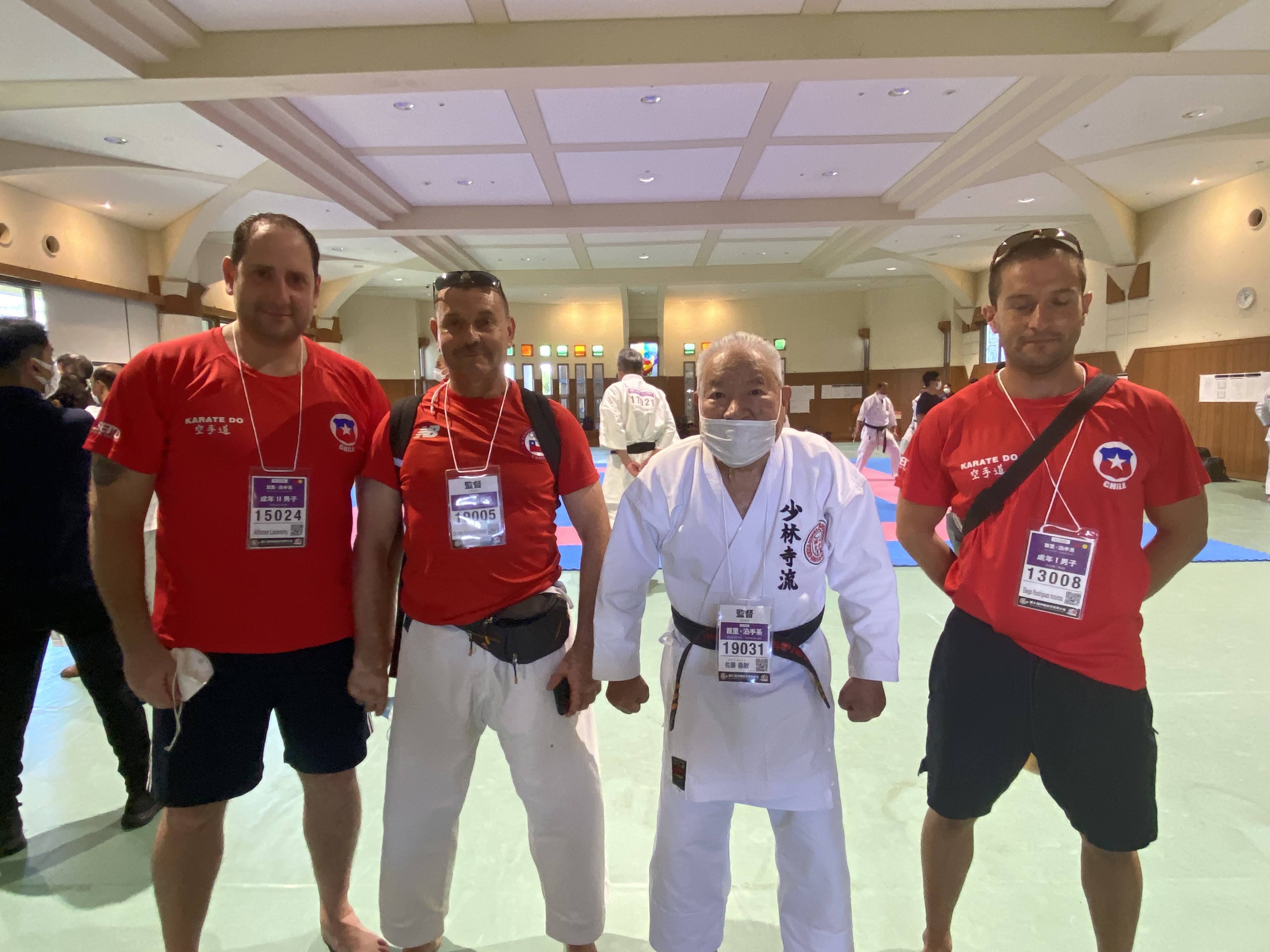
The second moment was carried out by 90 years old Yoshitoshi Sato sensei, Shorinji Ryū – Seishinkan Karate do Renmei, who despite prevailing contemporary beliefs, presented an inspiring Sesan kata within the framework of the qualifying rounds for competitors from remote island of Okinawa, mainland Japan and Overseas – Senios Male シニア男子 division.
Yashiaki Kohagura, 70 years old Shorin Ryū Hanshi, 9th Dan
Yoshitoshi Sato sensei, Shorinji Ryū – Seishinkan Karate do Renmei
AN INTRODUCTION TO THE FIVE DIVISIONS: Naha-te, Shūri/Tomari-te, Uechi Ryū & Kobudō 那覇手系の部, 首里・泊手系の部, 上地流系の部, 古武道 (サイ – 棒)
NAHA-TE; is based upon the Chinese martial art that spread to Kume Village, which Kanryo Higashionna taught to his pupils after he studied in Fuzhou, China. His direct descendant Miyagi Chojun, founded Goju-ryu and the katas are characterised by their emphasis on physical strength.
SHURI/TOMARI-TE; Shuri-te developed in Shuri首里 during the days of the Ryukyu kingdom and was passed on from Matsumura Sokon to Anko Itosu. His pupil, Chochin Chibana founded later Shorin-ryu, and Gishin Funakoshi was the founder of Shotokan-ryu. Tomari-te developed in Tomari, a port of trade. Kosaku Matsumora is considered the forefathers this martial art. Kata of both Shuri and Tomari-te are characterised speed and flexibility.
UECHI-RYU上地流; Kanbun Uechi learned the martial art from Oangai Noon, and Kanai Uechi, his son, incorporated modern elements in order to complete the Uechi-ryu system, an style characterised by training the physical body to its utmost limits, reason why it has gained hight acclaim as a martial art that may be used in actual fight.
KOBUDŌ古武道; after the satsuma clan invasion to RyūKyū 琉球, individuals were prohibited from using bows, arrows and swords. As a consequence of this, people studied ways in which to turn everyday tools into weapons and this knowledge was passed along to develop Kobudō古武道, a unique martial art founded in Okinawa that find its development alongside karate 空手
Through a scoring system, on August 4 and 5, the preliminary rounds for people from overseas, mainland japan and remote island of Okinawa were held to determine the 12 competitors that will join the main tournament along the four from Okinawa, determined earlier this year. And so, on the 6th, the main tournament began with the round of 16 and quarter-finals determining the qualifiers who would fight for the top positions the next day at the Prefectural Budokan Arena.
The arrival of our team to Okinawa took place about a week before the start of the tournament and the planning included acclimatisation training both physically and technically at Uechi sensei’s dojo as part of the final preparation for the event.
The very high levels of humidity will always represent an important aspect to consider in the acclimatization process, especially for those competitors who come from the southern hemisphere, which at this time of year are going through the winter period.
Added to the high temperatures, the body responds differently from the physiological point of view, permeating individual perception and performance in the kata execution. The management of breathing and the search for the proper balance in the levels of muscular contraction become a primary objective during the preparation, which must begin well in advance by being able to identify a low, medium and high execution intensity, which should be fundamentally based on the self-perception of effort – “Knowing yourself, is the beginning of all wisdom“, Aristotle use to said.
一心流沖縄伝統空手道協会 – スンスウ形 – 沖縄2022
“The four days of competition became very intense from a mental point of view as I tried to maintain concentration and a balanced emotional state for everything I felt was at stake. It was a very special preparation to get to that moment.
Considering that the first participation in 2018 did not have a happy ending, managing expectations also became a key issue during the process”
diego rodriguez, when asked for a quick impression in an interview with a local newspaper in sweden.
As the days passed, the levels of confidence increased and the mental factor took over. Nerves and expectations will always play a role in instances like this and knowing how to handle them should always be part of the specific training process. How to position yourself in the main tournament, within the 16 competitors with the highest score, begins in the qualification round and the score obtained, which determines “the path to the final”
Performances with excessive tension, loss of balance and competitors forgetting the kata are some of the things that can be observed frequently. After all, it has been 4 years of waiting to earn the classification and a position in the final tournament that ensures a relative peace of mind on the way to the final.
Round of 16 and Quarterfinals were held in one day, leaving the semifinal and final for the next, creating a state of tension in which again the mental factor plays an important role.
Focusing on a years-long preparation process for a tournament with such specific and particular objectives, I believe, guarantees learning and growth even when medals and podiums are not achieved. The cultivation of the indomitable spirit through constant training regardless of the circumstances day after day and year after year awakens ever higher levels of technical and, above all, mental understanding. Commitment to oneself is the only thing one has the power to control because circumstances change every day, but those things that one wants most in life I believe, must always remain as the beacon that guides us.
On the last day of competition, you can only see the select group that made it to this stage. Despite the tough competition with truly exceptional performances, the human quality of all the competitors stands out, who, despite the results, interact with a genuine intention of friendship and happiness for having given their best. This is one of the essential objectives of the event: to create an opportunity for Okinawan Karate enthusiasts from all over the world to meet and interact in “the birthplace of karate”, as well as to preserve and properly pass on the techniques and spirit of Okinawan Karate”
ISSHINRYU, SILVER AWARD – SHURI/TOMARI-TE KEI 一心流首里・泊手系 銀賞
首里・泊手系 銀 賞 – 沖 縄 空 手 世 界 大 会
Seishinkan Budō, through its founder, Osvaldo Rodriguez sensei, set foot on Okinawan soil for the first time approximately 28 years ago, with the aim of establishing a direct link and knowledge from the birthplace of karate. Through constant visits with some students on occasions and individually on others, the link with Okinawa through our sensei there increased with as the time passed. The commitment to support the expansion and preservation of Isshinryu has been a cornerstone of our school since the earliest days alongside Grandmaster Angi Uezu and Uechi Tsuyoshi sensei today.
World tournaments have always been a great platform for promotion and attracting the attention of enthusiasts around the world. Our school has always been present in the versions since 1995 with Okinawa Karate Kobudo World Pre-Tournament, seeking to position and represent Isshinryu as high as possible, a task that we have finally been able to achieve on this tour.
All those who were directly involved over the years and from all over the world agree that this has been a historic moment. Osvaldo Rodriguez sensei, together with Diego and our former students, sincerely hope that this will be a significant contribution to the work that Uechi Tsuyoshi sensei carries out as a representative of the style at the Karate Kaikan and who was ultimately responsible for positioning the Isshinryū katas on the official list. We sincerely understand that it is not a simple task.
金賞 – 銀賞
金賞 – 銀賞
銀賞
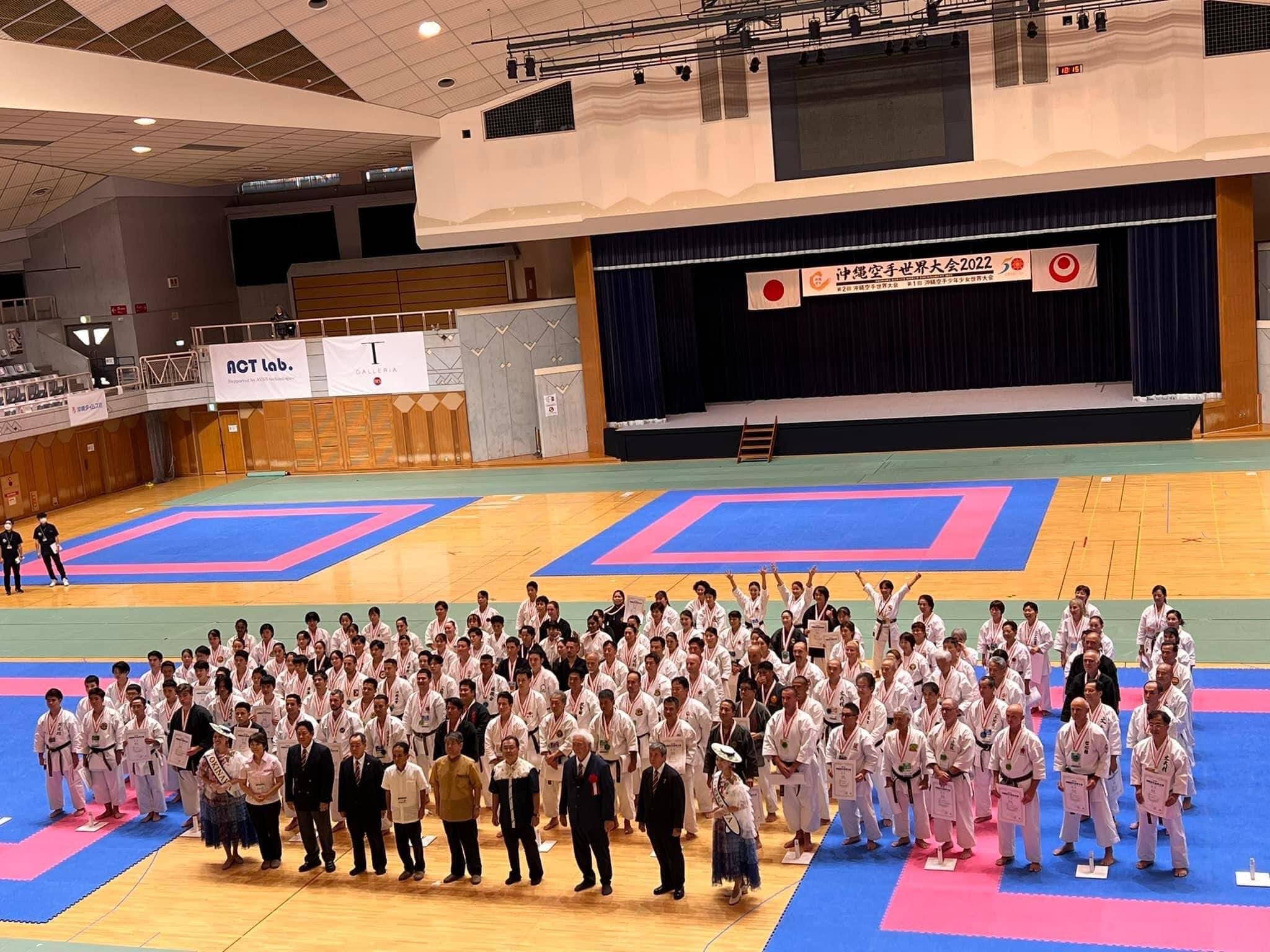
AWARDS CEREMONY
PODIUM OFFICIAL PHOTO
ISSHINRYU SUNSU KATA – Finals
金賞 – 銀賞 – 銅賞
And finally, at 3:30 p.m. on August 7, 2022, Diego Rodriguez, who lives and teaches Isshinryū Karate in Sweden, entered the Okinawa Prefectural Budokan Arena, together with Osvaldo Rodriguez sensei, to dispute the final of the Shuri/Tomari-te Kei, Male I category on the Court 1. In front, the 27-year-old representative from Okinawa, who ended up taking the gold award in what was a great presentation by the two karateka.
The great triumph was without a doubt having had the chance to present, in the words of Diego himself, “one of the best katas of my last training period. It has been here, in Okinawa, during these two weeks that I have been feeling that my kata has matured, I keep discovering more elements to pursue in my training“
Once again we thank all those who followed us and sent their best energies throughout the tournament. For keeping us in your thoughts and for following each presentation of Alfonso Lavanchy and Diego Rodriguez in each division and opportunity they had to participate.
首里・泊手系 銀 賞 – 沖 縄 空 手 世 界 大 会
“It is impossible for me not to thank our sensei in Okinawa, Tsuyoshi Uechi, for walking a path that should not be easy. Despite being a humble person and a low-profile sensei, standing up and showing Isshinryū in Okinawa is not an easy task within a culture that places such tremendous value on hierarchy, legacy and respect for traditions. I consider myself deeply honored to reap the efforts made by him and a lot of people who have been traveling to Okinawa from abroad for many years trying to accomplish things and support this effort.
I believe that a beautiful achievement takes a long time and ultimately involves lifetime considerations. They require a huge and coordinated effort of people so that everything is in the right place at the right time. For this reason, my gratitude to Osvaldo Rodriguez sensei and all those students who have supported our dojo. To those who have traveled to Okinawa for the last 27 years since Osvaldo sensei stepped on Okinawan soil for the first time, seekingknowledge and supporting Uezu Angi sensei -who was the man who ultimately gave us an opportunity, opening the doors of Okinawa for all of us . To the best of our abilities, we work every day to contribute to the preservation of Isshinryū on the path that Uechi sensei leads today in the Karate Kaikan, and I hope that my achievement is a humble contribution to this lifelong effort.
I predict that many people from Isshinryū will come to Okinawa now, especially in 2026, with the certainty that they have a place, a true platform to display the fruits of their efforts in a truly beautiful stage where tradition meets new, combining core values of traditional-karate with the modern, giving rise to friendship, cultural exchange, and most importantly, a place to promote Karate and Okinawan culture“
FINAL REMARKS
The logistic deployment of the organising committee of the second world tournament can be appreciated through the links that the reader can find below. Seishinkan Budō Sweden invites you to visit the following links of interest, where you can find from the final results of the tournament, videos of the inaugural demonstrations to the full streaming of the award ceremony and the entire event via Youtube.
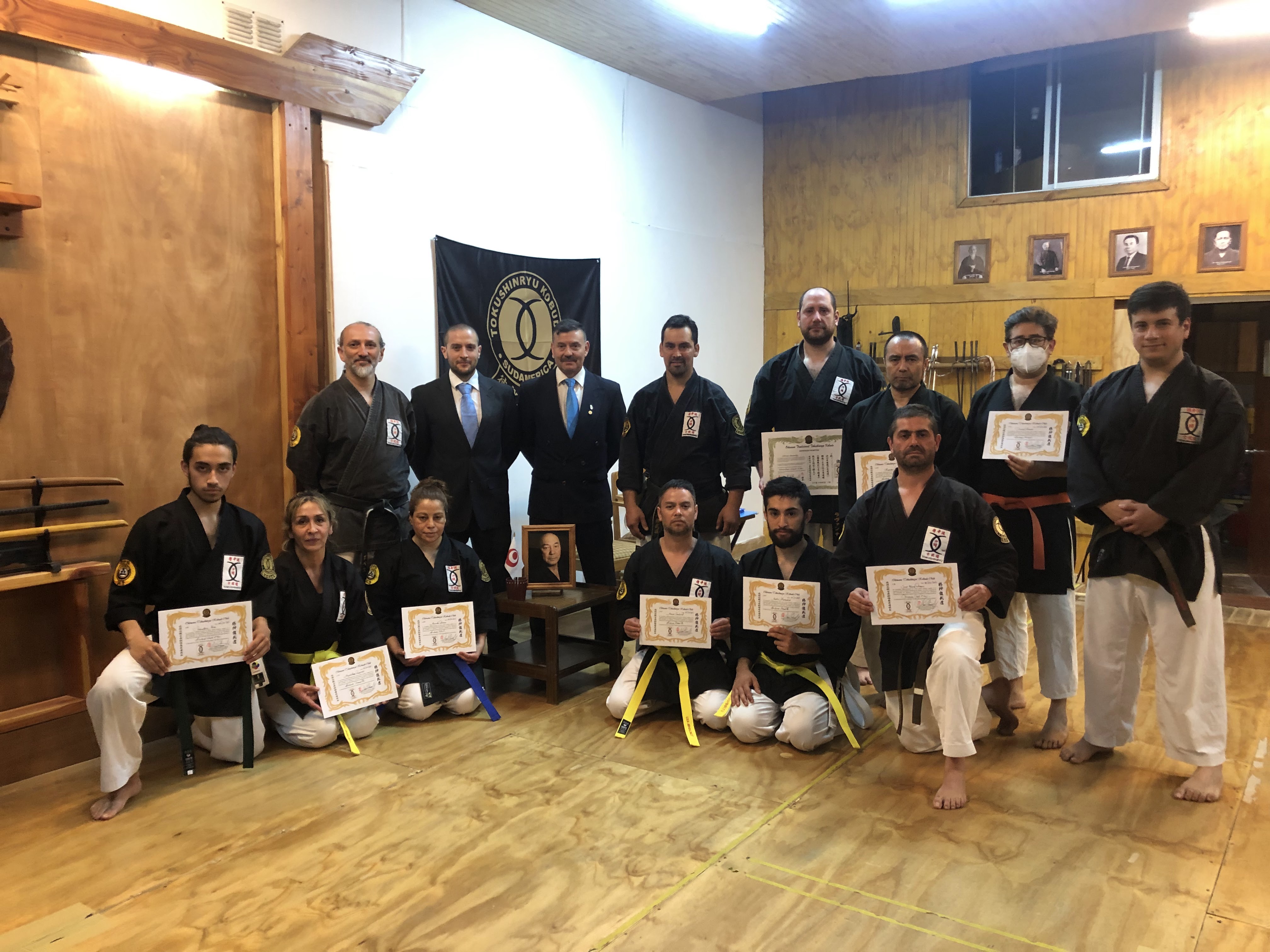
As part of a new trip to Chile between the 11th of December and the 7th of January, the Tokushinryū Kobudō summer camp and rank promotion was held at the South American honbu dojo. Kyū rank promotions took place alongside Ivan Parra sensei and Alfonso Lavanchy (Tokushinryū Kobudō Los Angeles and Santiago representatives respectively) who were promoted to Ni dan.
BŌ – TONFA KUMI TRAINING
BŌ JŪTSU SESSION
SAI JŪTSU SESSION
KYŪ RANK PROMOTION – December 2021
NIDAN PROMOTIONS – December 2021
SAI JŪTSU SESSION
LONG WEAPONS SESSION
At the board meeting, held on August 19, 2021 in Stockholm, it was agreed to appoint honorary members and special advisors of Seishinkan Budō Sweden as a token of appreciation for their support and guidance focused on who leads the group in Sweden, sensei Diego Rodriguez, Isshinryū Karate Godan and Tokushinryū Kobudō Nidan, who moved to the Swedish capital within the framework of a personal development project and whose main objective has been the establishment of our school in Europe, from which the stimulation and development of cooperation ties with other schools can take place, thus benefiting the students of our school and all those who are linked to the practice and development of martial arts.
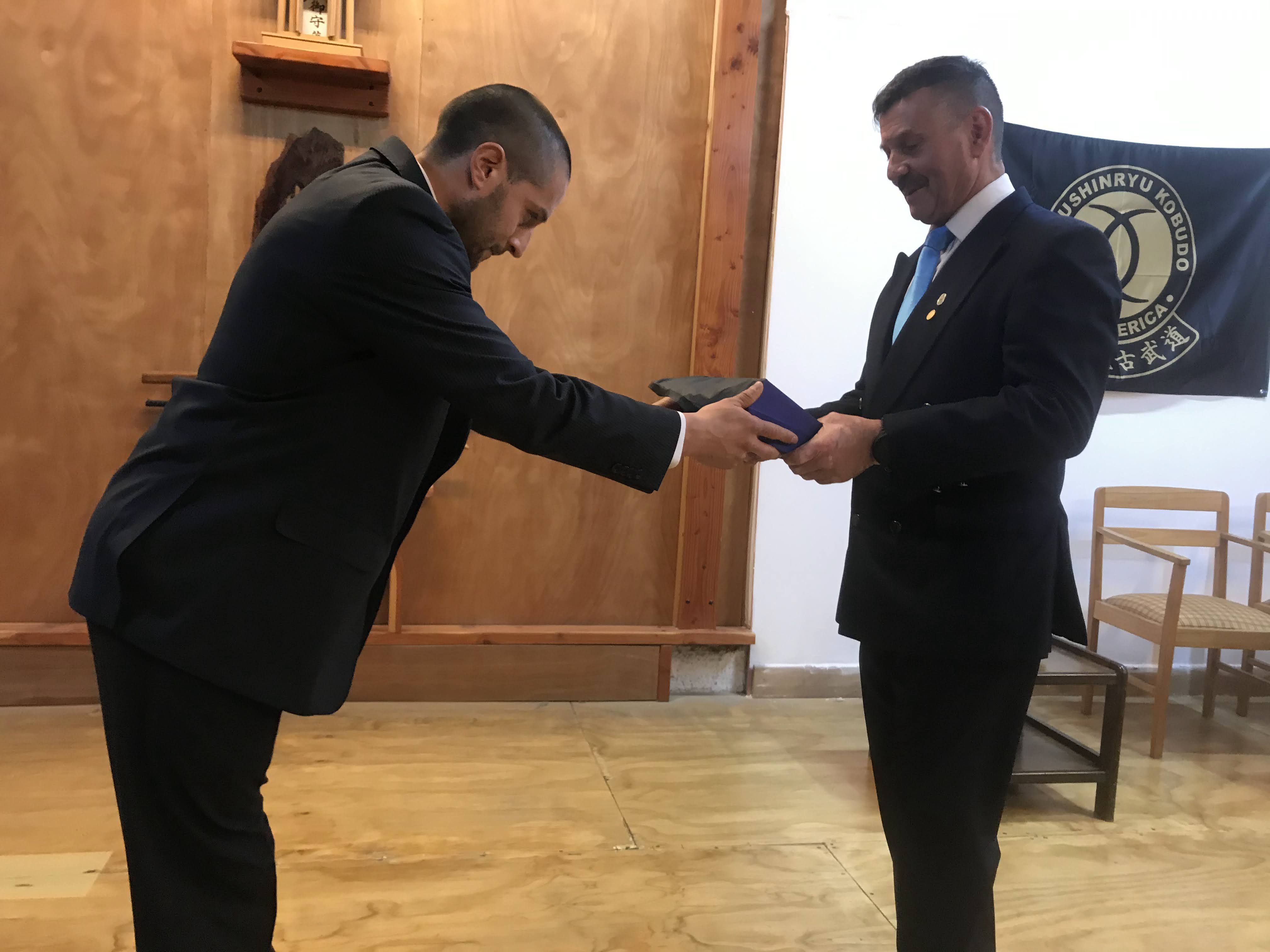
Taking advantage of this relevant event, Osvaldo Rodríguez sensei and Iván Parra sensei were recognised in honor of their merits and important contribution in the establishment and foundation of the headquarters of our school in the city of Stockholm, Sweden, which officially began operations on May 10, 2021.
OSVALDO RODRIGUEZ SENSEI – Seishinkan Budō School, President & founder. Concepcion, ChileRECOGNITION & AWARD CEREMONY – Chile, December 2021IVAN PARRA SENSEI – Seishinkan Takeshi Budō, Los Angeles ChileOsvaldo Rodriguez – Ivan Parra – Diego Rodriguez
EVERY JOURNEY BEGINS WITH A FIRST STEP
Undoubtedly, the bond established with the representative of Isshinryū Karate and Tokushinryū Kobudō in Europe, sensei Lars Andersen, was and continues to be a cornerstone in the present of our school in Sweden. This connection can be traced back to the year 2001 in Atlanta, USA, where Osvaldo Rodriguez and Lars Andersen sensei had the opportunity to share in the framework of the Traditional Okinawa Rengokai Karate & Kobudo World Championship, where Uechi Tsuyoshi sensei taught the corresponding Isshinryū seminar.
This relationship would extend years later through Diego Rodriguez, who traveled to the Danish capital in 2016 as part of a personal project, establishing contact with Lars Andersen sensei and beginning a productive and important relationship through the practice of Isshinryū Karate and Tokushinryū Kobudō to this day.
OSVALDO RODRIGUEZ SENSEI
Seishinkan Budō School president & founder – Honbu dojo, Chile.
Isshinryū Karate 7th Dan – Tokushinryū Kobudō 4th Dan. He began his Karate training in 1973.
“Issued as plenary recognition for his important contribution in the founding process of Seishinkan Budō in Europe and as a consequence, to the expansion of the spirit and teaching of Budō in the region”
IVAN PARRA SENSEI
Seishinkan Budō – Takeshi Dojo, Los Angeles, Chile
Isshinryū Karate 6th Dan – Tokushinryū Kobudō 2nd Dan. He began his Karate training in 1986
“Issued as plenary recognition a the trajectory and significant contribution to Seishinkan Budō School throughout the years and to the development and expansion of the Okinawan Karate & Kobudō in Chile”
————————————–
We hope with this, to contribute in the recognition of some of the many representatives of Isshinryū Karate, Tokushinryū Kobudō and related arts in all five continents.
Seishinkan Hombu Dojo, Concepcion – Chile. July 1st, 2020.
As usual and following the calendar of activities for this 2020, the examination process for black belt applicants in Chile has officially started on July 1st.
On this occasion, the following students have been summoned to be tested for their next respective ranks:
Mr. ALFONSO LAVANCHY, Nidan applying to Sandan – Seishinkan Omokiri Dojo Director, Santiago, Chile. Mr. JOSE MIGUEL RIESCO, Nidan applying to Sandan – Seishinkan Taiki Dojo Director, San Pedro, Chile. Mr. PAULO VERA, Nidan applying to Sandan- Hombu Dojo Concepcion, Chile. Mr. RODRIGO MONARDES, Nidan applying to Sandan – Hombu Dojo Concepcion, Chile. Mr. GERARDO SALDAÑA, Shodan applying to Nidan – Hombu Dojo Concepcion, Chile. Mr. JUAN MANUEL SEPULVEDA, 1st Kyu, applying to Shodan – Hombu Dojo Concepcion, Chile.
All applicants have been holding for the past few years a consistent period of regular training in addition to developing and participating in support activities in their respective training groups, which is undoubtedly transferred to the rest of the students from the different dojos in the country.
Obeying history and complying with the standard of our organisation, the instance that takes place once a year, contemplates a long process that begins with the two most relevant aspects of evaluation: the theoretical/research aspect and off course the practical / technical part. The latter has been strongly modified in order to adapt to the current health circumstances that affect the regular operation of the honbu dojo, which prevents the regular training aimed at supporting the group. For this reason, an online training calendar has been established, in which it is intended to support more specifically the individual process of each one by the team of senior instructors.
The examining commission, chaired by Osvaldo Rodriguez Sensei, will be completed by the senior Seishinkan instructors team as follow:
OSVALDO RODRIGUEZ Sensei, Nana dan, Seishinkan Budo School – President. IVAN PARRA sensei Roku dan. Seishinkan Takeshi Budo, Los Angeles, Chile. DIEGO RODRIGUEZ sensei, Go dan. Seishinkan Budo Europe. Stocholm, Sweden. MAGALY INZUNZA sensei, Yon dan. Seishinkan Honbu Dojo, Concepcion, Chile. MAURICIO LOPEZ sensei, Yon dan. Seishinkan Tamashi Dojo, Los Lagos region, Chile.
THE PROCESS –
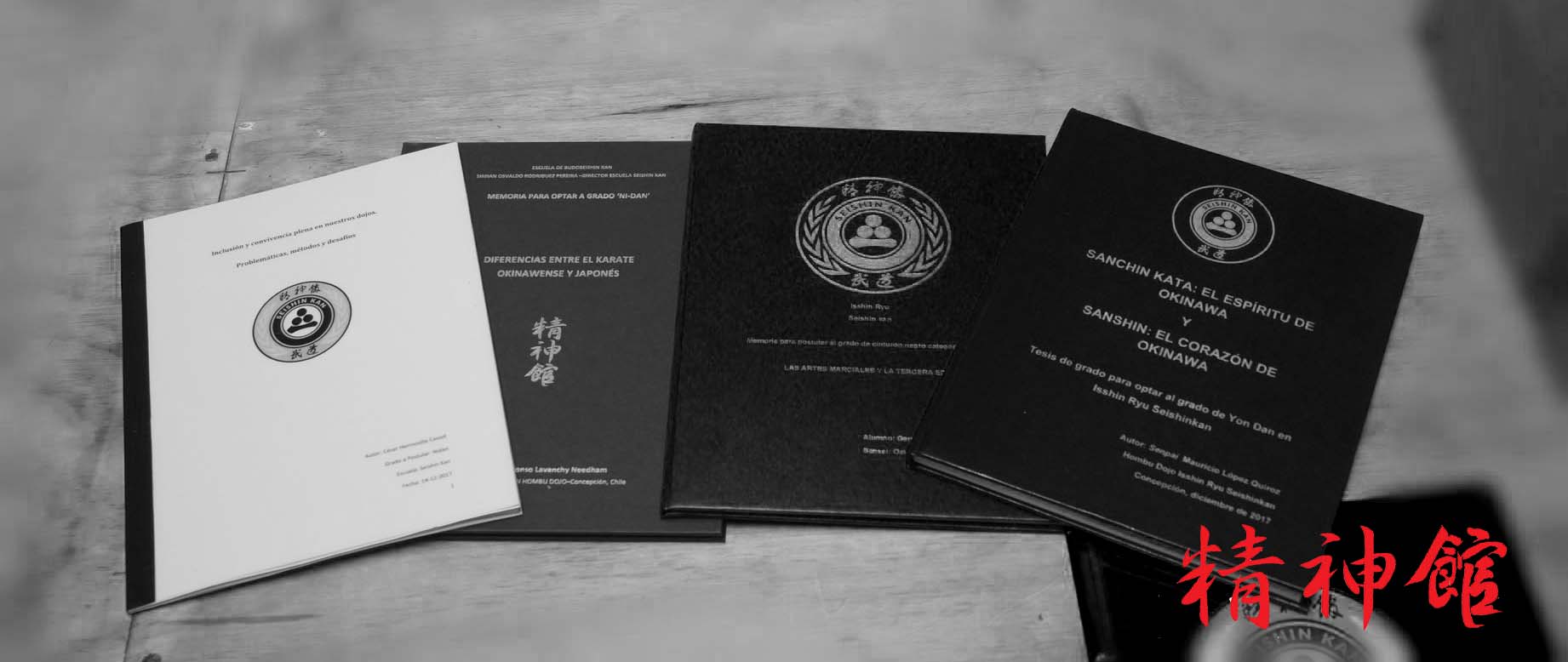
As is already known, the historical standard of our school invites applicants to develop a research topic that begins officially from the moment they are summoned to take part of the process.
Throughout history, the school has seen very interesting investigations, all oriented towards the practice of martial arts (and available in the Seishinkan honbu dojo library, for all interested in reviewing them), ranging from practicing karate 空 手 as a physical activity and / or sport (with volumes of physical conditioning, training systems, exercise physiology, physical therapy, nutrition, etc), the role of pedagogy in the process of teaching martial arts to specific groups of people (pre-schoolers, teenagers, adults, seniors and how this can effectively support the process of formation and education within the formal and non formal aspect), the historical perspective and development of karate do and martial arts (fundamental role of the historical process of Okinawa 沖 縄 in the future development of karate do 空 手 道, history of Isshinryu 一心流 in different parts of the world, etc.) and a look from the sustainable leadership point of view and how to develop it effectively with the aim of achieving a sustainable organisation of martial arts, with all the angles and perspectives that this implies.
This slideshow requires JavaScript.
This year and for the first time in history, a particular topic will be the one that will bring the whole group together, thus directing individual efforts towards a collective good which is intrinsically related to the topic itself: “Seishinkan, a school for life”.
In Osvaldo sensei’s own words, “the main premise in this new way of evaluating will be working as a team, so that the written document will be developed in a single topic addressed by all together”
On October 30, the written document must be completed and available for reading by the members of the commission who will have until November 7 to review it, the date on which the presentation will take place via teleconference at a time yet to be confirmed, carried out in Spanish and will be open to all interested parties upon registration (Click here to make your registration).
The technical / practical part, fundamental and mandatory to finalise the examination process, was initially planned for January 2021, with the aim of giving margin to the health crisis derived from COVID-19 that may affect the possibility of carrying out that instance one one hand, and affect the travel itinerary of some members of the commission from abroad on the other.
In this opportunity, all the corresponding Isshinryu technical program for each level will be evaluated, in addition to the Kumite 組手, Kobudo 古武道and Tameshiwari.
ACTIVITIES CALENDAR –
A comprehensive time frame has resulted in a clear schedule in which applicants must comply, among other things, with attending individual training and support sessions via teleconference with part of the team that will evaluate the process and at the same time prepare the research whose results will be presented under the same desire to provide students with tools that contribute to the process of individual development.
This process is also aligned with the institutional mission of our organisation through the specific objectives it pursues. Namely:
“Nurture constantly our students of different knowledge concerning the practice of Karate-Do Isshin Ryu 一心流, oriented towards the maximum theoretical and technical development of all Seishinkan students”.
“Stimulate and generate in our students the ability to transfer the Dojo’s learning to everyday life”
“Deliver practical tools for personal development”
“Nurture our students of solid philosophical foundations that contribute to the search of a personal path of grow”
In this way, the activity calendar provides a clear guiding thread to successfully complete this process.
“Without a doubt one of the great virtues of our school is resilience. Rising, adapting and dealing with circumstances, sometimes disastrous, like a wind in our favor, is something that is at the foundation of Seishinkan. Today is not the exception. Despite the complex moment that our country and humanity are suffering with the contingency of COVID 19, Seishinkan has once again agreed to reinvent itself and will make the project “Black Belt Exam 2020” a historic moment for our school. Without losing the real essence of face-to-face work in the Dojo, but adding the tools that we have in our favor today, a new exam modality has been planned. It will undoubtedly be a great challenge that will once again make our mark. I do not doubt the effort, commitment and dedication of each one of the summoned, from whom I hope the best. My trust and that of everyone is placed in them. For my students, strength, discipline and correct attitude. Never forget: -A true warrior see the invisible, feel the intangible and achieve the impossible-“
OSVALDO RODRIGUEZ SENSEI Seishinkan Hombu Dojo President
“Year 2020. This year has brought us new challenges, new challenges that lead us to meet our deepest self. This year has filled us with fear and torment, but it is up to each of us to succeed. For Seishinkan, this black belt exam is a new way of facing life with pro-activity and resilience. Flexibility; you have to adapt to the circumstances that life offers us, always focusing on the good of situations, despite the harsh and intense they are. The greatest challenge of this exam will undoubtedly be being forced to find yourself and work on your personal limitations. To all the students in the exam: life is giving them the opportunity to be part of a story. Much strength, patience and love towards yourselves”.
Without further ado, Seishinkan and all its members wish everyone the best of success in a process that is expected, stands out for the growth and learning of the entire group involved, and for them to successfully transform the circumstances that have marked this 2020 in something productive that helps them achieve the objectives and goals set.
To those interested in following the process and being part of the videoconference in which the results of the written work will be presented, we invite you to contact us through the following link.



















 “Year 2020.
 SEISHINKAN BUDŌ SCHOOL - Älvsjö Karate & Kobudō