
Today, martial arts, and karate in particular, are often viewed narrowly, either as self-defense or as a health-promoting activity. While both are widely valid, the best traditions of modern martial arts understand that combat effectiveness and health promotion are part of a holistic development that includes a high educational value, perfectly applicable, and even necessary, some might argue, in today’s society.
In an effort to pursue this ideal, Seishinkan Budō School has been implementing this holistic approach since its founding in 1987, with special attention to applying martial arts to the challenges of modern society, with children always being a special focus of development during our 38 years of operation with multiple generation of students taking part of our programs and parents placing their trust in our team of instructors.
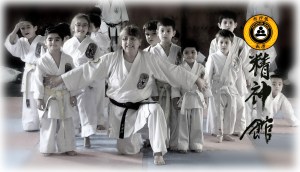
Our children program is designed to complement and support the formal educational process our students pursue at their schools. In a traditional Okinawan martial arts training environment and through recreational activities, students develop basic motor skills and fundamental values that permeates all human relationships. In a martial arts environment and in a mixed group of adults and children, students learn their place in the dojo while strengthening their self-confidence.
Starting from the age of 9 with a few exceptions (depending on the child’s level of independence) we offer tutoring twice a week.
We cordially invite you to read more details about our program below, or contact us directly via our email seishinkanbudoschool@gmail.com.
どうもありがとうございます
Domo Arigato Gozaimasu!

SEISHINKAN BUDŌ SCHOOL – Isshinryū Karate: A comprehensive, Integrated & Integrative experience.
Comprehensive: because it considers the student as a whole, not focusing exclusively on physical and motor development. Students also cultivate Okinawan martial arts in conjunction with the culture where this martial art originated, promoting a balance between intellectual and physical development.
Integrated: as it is a formative activity taught in a pedagogical manner so that it can complement the child’s formal education process in schools.
Integrative: regardless of their abilities, limitations, or potential, everyone can practice martial arts. Systematic training is carried out respecting individual levels of physical achievement and motor skills, adjusting them to make it an educational experience with an educational objective that serves society and is not merely competitive.
FORMATIVE PRINCIPLES IN MARTIAL ARTS FOR CHILDREN
- Etiquette and Good Manners: which represents the fundamental basis to navigate the learning environment in a martial art. Procedures and etiquette are the pillars that allow to build an orderly, structured, and respectful environment for all students.
- Physical and Motor Development: under the principles of gradual progression and systematic repetition, physical fitness is developed with special emphasis on the child’s motor development through multiple and diverse exercises.
- Knowledge and mastery of the Techniques: where the child will seek to develop the skill, technical efficiency and aesthetic sense aimed at perfectly mastering the elementary movements in karate based on balance, management of the center of gravity (“tandem”, “Hara”), posture and breathing.
- Mental and spiritual development: reserved primarily for students with years of dedicated practice who, through adapting their behaviour to an ethical and moral code called the “Code of Būshido,” achieve the awakening of mental and spiritual faculties. Self-knowledge, self-control, and meditation, among other relevant aspects, will guide the student through this stage.
ISSHINRYŪ KARATE – DOJŌ PRINCIPLES:
- Discipline:
- Correct attitude that every martial arts student must cultivate both internally (self-control, control of one’s actions and words towards others, self-knowledge) and externally (following the protocol and rules of coexistence when interacting with peers and elders)
- Respect:
- A value that, both individually and collectively, permeates all human relationships, both inside and outside the dojo. It is developed in each class through joint training with other dojo members, work with a partner (Uke), and adherence to the protocol for each class. It’s therefore, embedded in our daily operation.
- Basic Technique:
- Begins the physical practice of karate-dō through the execution of established patterns of movements consisting of positions, hand and leg techniques in order to develop maximum efficiency and body control in each movement.
- Kata:
- Forms of pre-established movements, executed in a harmonious and progressive sequence, which are deeply rooted in ancient Okinawan fighting traditions. They transmit a series of techniques through an “imaginary combat,” which enhances body balance, correct breathing, handling, and shifting of the center of gravity. Isshinryū karate has eight empty-hand kata: Seisan, Seiunchin, Naihanchi, Wansū, Chintō, Kusankū, Sunsū and Sānchin.
- Self Defence:
- Practical application of the four previous principles, which is developed with the other practitioner with the goal of improving the appropriate reaction to an unexpected aggressive situation. Always under the Sensei’s supervision, the goal is to develop maximum technical efficiency to control a real opponent in a real context.
- Kumite:
- The final practical stage of Isshinryū, which begins after years of intense training in the five previous principles have passed. In this stage, self-control in technical application and self-mastery, combined with the virtue of temperance, come together to calm the mind in a real combat situation.

 SEISHINKAN BUDŌ SCHOOL - Älvsjö Karate & Kobudō